Conspit CPP Series Hydraulic Pedal Set
Conspit is a manufacturer of sim racing hardware located in Shanghai, China. They not only develop hardware such as pedals, handbrakes and sequential shifters, but also rigs, formula seats, a full formula style monocoque and even a 270 degree screen equipped with multiple projectors. Therefore Conspit certainly is an ambitious company with a serious collection of sim racing hardware. Some time ago, Conspit contacted us to ask if we were interested in reviewing one of their pedal sets. We were immediately enthusiastic and naturally we couldn’t say no!
At the time of writing, Conspit offers two pedal sets; the CGP pedal set with a load cell brake pedal and the CPP pedal set which is a pedal set equipped with a hydraulic brake pedal. Both sets are otherwise identical and available in a set of two or three pedals in the colors black/gold and red/chrome. We received the CPP Hydraulic Pedal set with three pedals in the color combination black and gold. The most affordable option, the CGP Load Cell set with two pedals, has a price tag of ¥2699 Chinese yen, which is about €374.55. The Conspit CPP Hydraulic Pedal set as we will be reviewing has a price tag of ¥ 4299 Chinese yen, which translates to about €584.11 excluding shipping costs.

Packaging & Contents
The Conspit CPP Hydraulic Pedal set was shipped from China, through the distribution center in Poland, and took about six weeks to be delivered to us. That is a pretty long delivery time and definitely something to take into account if you are interested in purchasing this pedal set. In our opinion this delivery time is just at the edge of acceptable for us if you are aware of this in advance, but in our case we had to wait and see. The package, which is a standard brown outer box, was neatly delivered to us by UPS and we did not have to pay any additional import or VAT costs upon receipt.


The CPP pedal set comes in a beautiful matte black box with Conspit branding which gives the impression that we are dealing with a high quality product. Around the box are images and specifications of both the CGP and CPP series of pedals, while a mounting template for the baseplate is hidden at the bottom, which we think is a smart and ingenious solution and at the same time a good way to use that space that was otherwise wasted. When opening the box, we initially see black foam with the Conspit sticker set on top, together with the warranty certificate and a stamp with the date on which it passed the quality control. Of the latter you could say that with every product you buy you could assume that it passed a quality control, but we think it is a nice addition to see a stamp confirming this. This gives us a sense of confidence and the idea that our set has been carefully inspected before it came our way.
When the top layer of black foam is removed, we can finally see the pedals as they are positioned firmly in more custom-cut foam. At first glance we are immediately impressed; the entire set looks very neat and well packaged and especially the cylinder of the hydraulic brake pedal stands out. What is also striking are the included anti-static gloves, which lie on top of the bags with parts, mounting materials and the USB cable. In the bag with parts and mounting materials we see all the bolts to put the pedals on the baseplate, bolts for mounting, tools in the form of Allen keys and Conspit branded keys, lubricant and different sizes and colors of brake rubbers (elastomers). What strikes us as well is that there is no manual or quick-start guide in the box. This will therefore have to be downloaded separately from the Conspit website.


Technology & Quality
Fundamentally, almost all parts of the Conspit CPP pedal set are made of CNC machined aluminum. This aluminum has undergone a T6 treatment, which is a code for a standardized system to indicate heat treatments of aluminum alloys and which says something about, among other things, the hardness of the aluminum and how this hardness was achieved. Thanks to all the aluminum used it is a very light pedal set, but at the same time everything feels very sturdy and solid. We even dare to call the finish of the pedal set sublime; all edges are visibly nicely finished, most of them in the beautiful contrasting color of the aluminum, and despite the fact that the lines of the design are very sharp, there is not a single sharp edge to be found. We also cannot find any imperfections that may result from the production process. This makes the Conspit CPP pedal set certainly one of the most beautifully finished pedal sets that we have had the pleasure of holding in our hands.


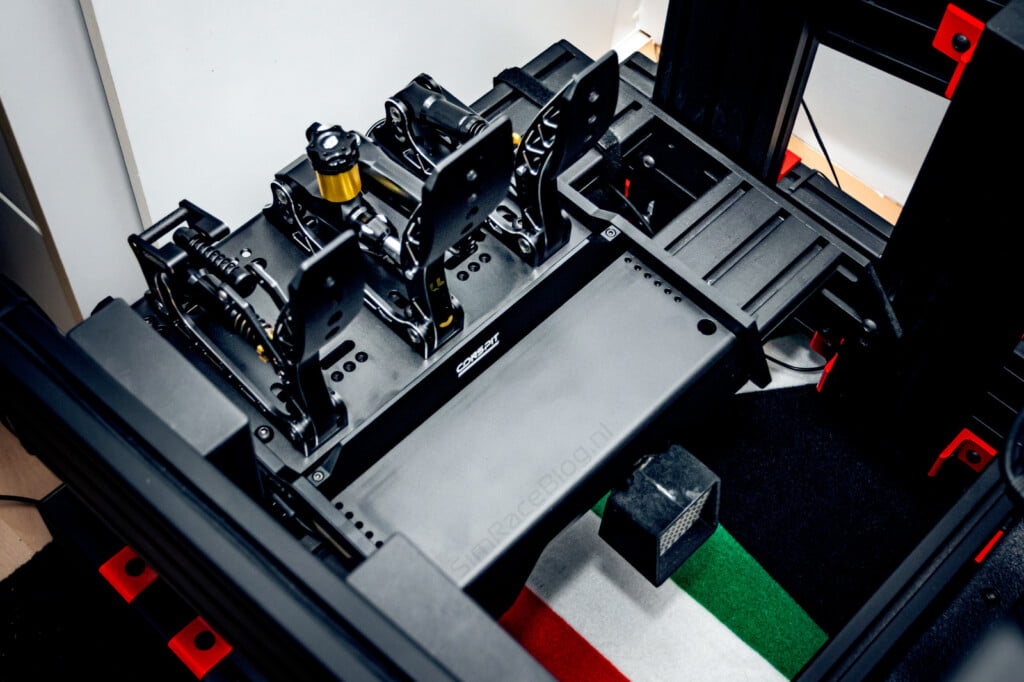
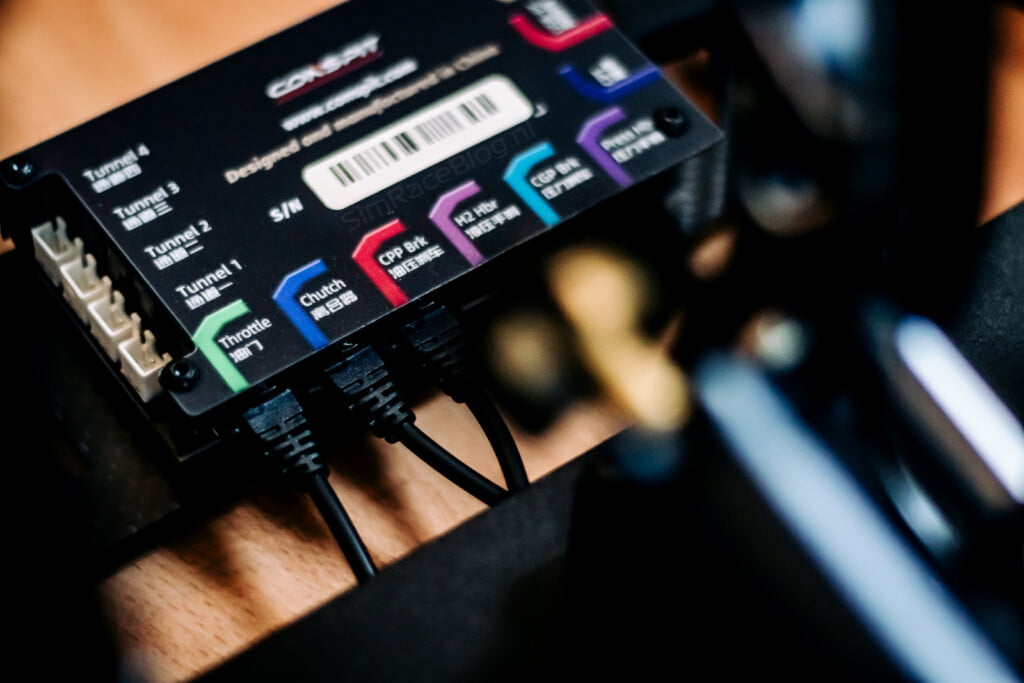
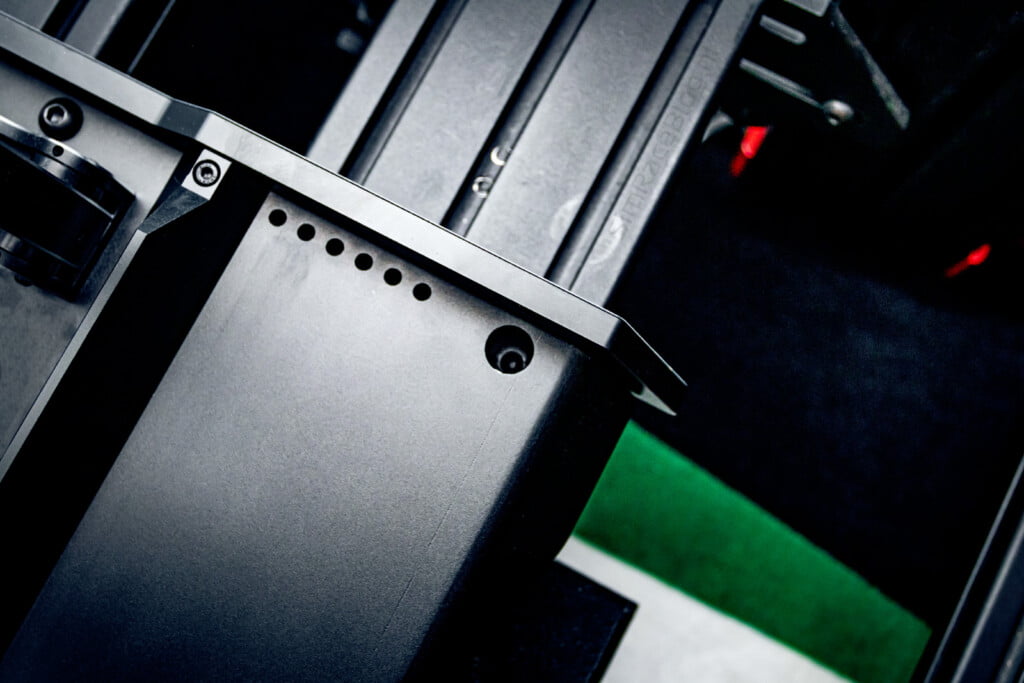
Besides the fact that the pedal set looks very nice and well finished, the practical and functional side of it has also been clearly thought through. The baseplate of the pedals is an important part of this pedal set as it also contains the controller and connectors. This is visible from the bottom of the pedals, however the heel plate must be removed to access it properly. The heel plate can be removed by loosening the raised edge, which is attached with 2 bolts. This raised edge to put your heel against is not only removable, but also adjustable. This way you can determine the distance from your heel to the pedal plates. There are holes in both the heel plate and the back of the baseplate so that you can turn the bolts that secure the pedal set from above. This is a small detail, but a very nice and practical one.



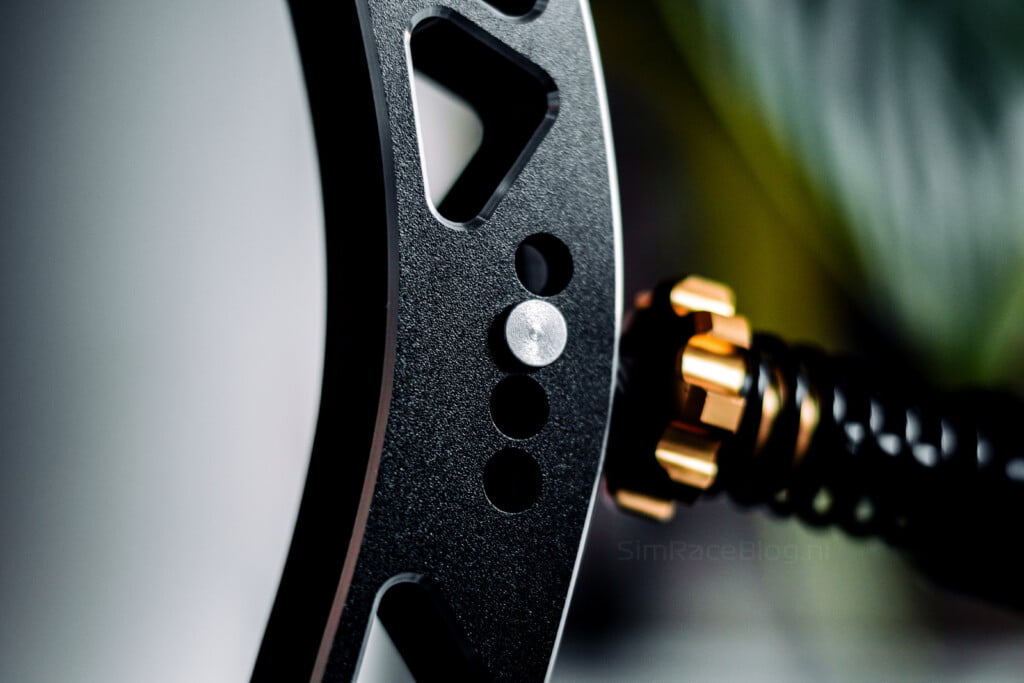
The accelerator pedal (as well as the clutch pedal) is equipped with a Hall Effect sensor. Of course we have seen and discussed those before, it is a sensor that can measure the strength of a magnetic field, and thus the position of the pedal, by means of a magnet. This sensor is contactless and therefore experiences no friction and theoretically has an infinite lifespan. It is striking that the Hall Effect sensor, which is often visible in other pedal sets near the hinge point of a pedal, is not visible with the Conspit CPP pedal set. This is incorporated in the cylinder where the shaft and the adjustable spring of the accelerator pedal are also located. This contributes to a neatly finished appearance of the pedal set. Finally, the pedal is equipped with a beautiful gold-colored adjustment ring, an accent color that we find very stylish and which is fortunately not too excessively present on this pedal set.




As mentioned, the clutch pedal is equipped with a Hall Effect sensor, just like the accelerator pedal. Also on the clutch pedal is a beautiful gold-colored adjustment ring for the large spring of the pedal. Furthermore, the clutch pedal has a mechanism that simulates the bite point of the clutch. An inventive solution has been devised for this, which feels extremely sturdy and which we believe can simulate the same pedal feeling time and time again. Apart from the fact that this system seems very inventive, it also looks very nice and sleek. A nice detail is the Conspit logo on the side of the bite point mechanism.


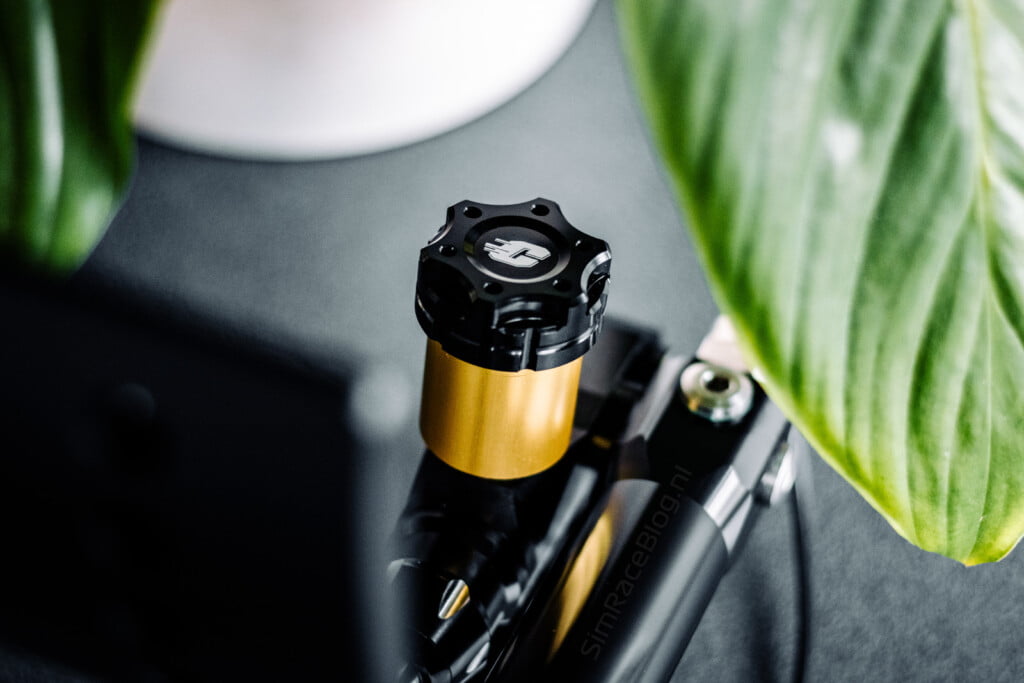
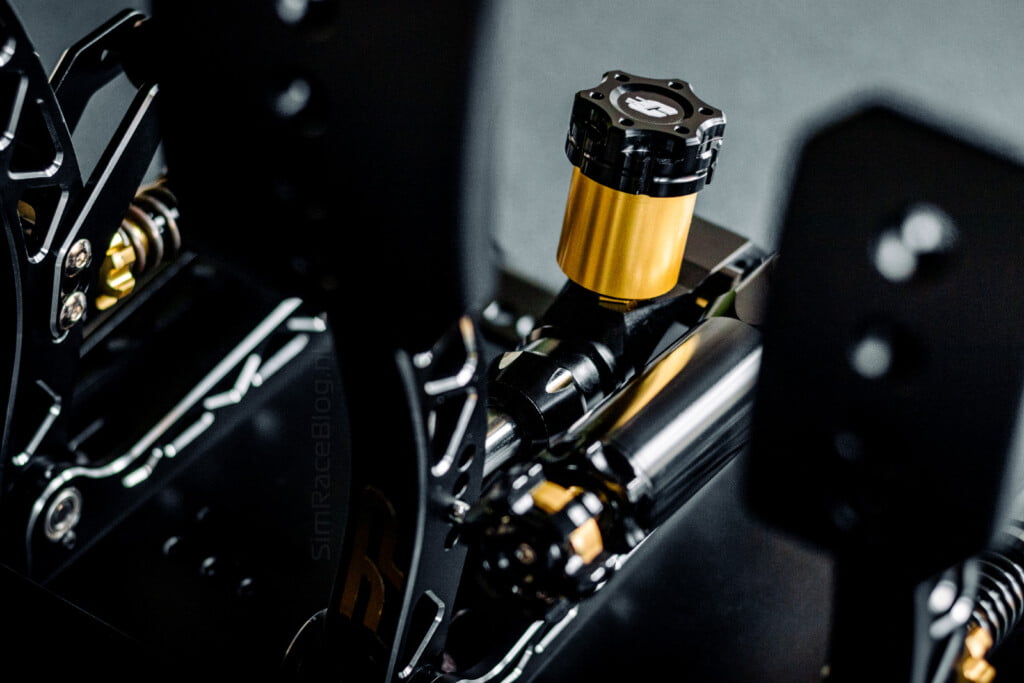
The eye-catcher of the CPP pedal set is of course the hydraulic brake pedal. We think it looks very impressive with the gold-finished fluid reservoir and large cylinder on the side of the pedal. As the description suggests, this brake pedal functions by building up pressure with hydraulic fluid in the pedal and then measuring this built-up pressure with a sensor. This way the brake input consists of the actual pressure that you build up with the fluid, which is by definition a bit more realistic than a load cell pedal that measures the braking force that you exert with your foot on the pedal. The brake pedal is equipped with a pressure sensor with a measurable range of up to 20Mpa, which equates to 200 bar of pressure. In addition to this pressure sensor and the hydraulic fluid, the brake pedal has a cylinder on the side of the pedal that contains two elastomers. With these elastomers and the supplied extra ones you can determine the hardness of the pedal and also set the preload / travel of the pedal. Pressing the pedal and compressing the fluid also compresses the elastomers. The pedal feel consists of both the pressure that you build up with the fluid and the compression of the elastomers that determine the hardness and stroke of the pedal. The hydraulic system of the brake pedal is also maintenance-free and the manual even explicitly states that no action may be taken with regard to the reservoir containing the fluid.


Assembly and mounting
Mounting the pedals on the baseplate is a breeze. The cutouts for the pedals are clear and adequate, and the baseplate is clearly prepared for use with both two and three pedals. Each pedal is secured with two bolts in the baseplate, which itself is threaded. It doesn’t get much easier! This does mean that the pedals are not freely adjustable in width, but that you have to use the available threaded holes to adjust the pedals sideways. In our view, however, the available options are sufficient. Underneath the pedal there are slots in the baseplate through which you feed the cables to send them to the controller unit with connectors. This ensures that almost no cable is visible, making the pedals look super sleek. In the photos below, the cables have not yet been concealed and connected as intended.


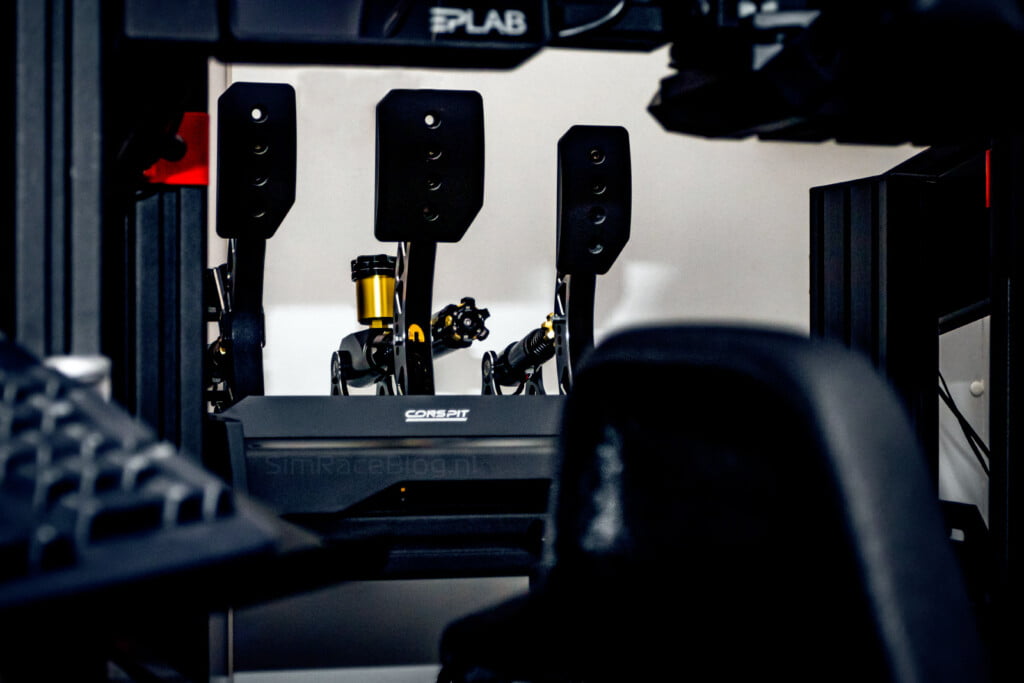
Our plan was to mount the Conspit CPP pedal set on our Trak Racer TR8 Pro, however, the pedals do not fit on the pedal deck of the TR8 Pro and in our opinion it was not possible to make it fit in a responsible way. So we are going to mount the Conspit CPP pedals on the FormulaSimRigs Avanzata rig. This pedal deck consists of adjustable aluminum profiles, which means that these pedals are extremely easy to assemble. Included with the Conspit CPP pedals are four bolts with the correct distance to be secured to the aluminum profile with an M8 T-slot nut. Assembling the pedal set was a job of no more than just a few minutes. The only comment we have is that no extra washers are included to fit between the aluminum profile and the baseplate, and between the baseplate and the head of the bolt, and that the bolt is just a little too short to fit washers yourself. In principle this is not necessary, but for our peace of mind and to minimize the risk of damage we would have liked some rings.


Adjusting
Besides the fact that it is very easy to mount the pedals on the baseplate and to place the pedal set on a pedal deck made of aluminum profiles, adjusting the pedals is generally extremely easy as well and in most cases doable without the use of tools. For starters, the front plate on every pedal is adjustable in height, and by a good margin too! The pedals can be made very short but also very long, which in our opinion gives a lot of freedom for users with both large and small feet, but also to adjust the pedal feel under your foot. Remarkably, the angle of the pedals cannot be adjusted. On the other hand, the raised edge of the heel plate can be adjusted in distance. Placing it further forward also increases the angle of your foot in relation to the pedal, which has about the same effect. For use in our formula sitting position, we leave this edge as close to the pedals as possible so that our feet are upright against the footplates and we do not have to overextend our ankles when operating the pedals.

On the accelerator pedal, by tightening the gold-colored adjustment ring with your fingers, the compression of the spring can be adjusted to reduce the travel of the pedal. This also makes the pedal a little harder, but that difference is negligible. Naturally, this travel will increase again as soon as you turn the ring back, but you may not loosen it further than what Conspit prescribes. You can adjust the accelerator pedal to be harder or softer by changing the angle of the spring. This can be adjusted in four steps by removing the removable pin, which you can simply push out with your finger, and raise or lower the axle and using the pin to fixate it again. Placing the spring higher makes the pedal heavier to use, placing it lower makes it lighter. With most pedal sets that allow you to adjust the angle of a spring, this is already quite easy to do, but Conspit has made this extremely easy without compromising on the firmness of the pedal.
As far as we can see and read in the manual, the clutch pedal has only one adjustment option apart from the front plate and that is the travel of the pedal. This can be adjusted just like on the accelerator by tightening or loosening the gold-colored ring. The pedal can therefore not be made lighter or heavier to operate. Whether this is a disadvantage will have to be seen when using it. When we look at the pedal it does seem like the angles of both springs can be adjusted, but this is not described as an actual adjustment option and therefore we have not opted to try this.
Moving on to the brake pedal. As mentioned, the hydraulic system of the pedal should not be tampered with, leaving the elastomers (except for the foot plates) as the only adjustment option. The gold-colored knob on the cylinder on the side of the pedal adjusts the preload and travel of the pedal, just like the accelerator pedal. It also makes the first bit of travel a little harder. If you unscrew this ring completely, and then remove the black ring that closes the cylinder, the elastomers will show themselves. You can replace these with the supplied extra ones. Basically you have two colors of elastomers; light yellow (which we find more green-yellowish), and bright yellow. In addition, you have two narrow elastomers (16mm) and two wide elastomers (18mm) of each color. The green-yellow elastomers are the lightest, while the bright yellow ones are the hardest. Naturally, the narrow elastomers are lighter than the wide ones as well. By combining different elastomers you can compose a total of 9 different hardnesses. Conspit has set out a nice table for this in the manual. Changing the elastomers is the only thing that cannot be done in an instant. Each elastomer should have a washer on either side to hold it in place. The elastomers must be greased both around and at the ends, so that a sealing ring must also be placed around the washers. Finally, there are metal plates in the cylinder where the adjusting ring, for the preload and the travel of the pedal, touches without damaging the elastomers. Removing the elastomers from the cylinder is not entirely easy since the deepest ring can stick and you cannot reach it very easily, however, if you want to mount a different size of elastomers with it’s compatible washer size, you will of course have to be able to remove them. Due to the complexity of replacing and greasing the elastomers you cannot really test different hardnesses in an instant to find your own preference, you will really have to take the time to do this. The pedals are delivered to us with a hardness of 8, which means that there is one green-yellow elastomer of 18 mm and one of 16 mm.
Software
After mounting the pedals, we obviously have to download and install the Conspit software called Conspit Link. The installer for this software, together with the latest firmware version for the pedals, can be found on the Conspit website. Installing it is a breeze and the software is also very easy to use. A small downside is that the software is basically written in Chinese and you have to manually set the language to English every time you use it, provided you are not able to read Chinese. Even with the software on English you can still find Chinese written text when you have adjusted a setting, but that is not disturbing while calibrating the pedals.
To calibrate the pedals, you have a ‘Min’ and a ‘Max’ button per pedal. You can press ‘Min’ in your pedal’s rest position to determine the starting point of the pedal and press ‘Max’ when fully depressing the pedal to determine the end point. In the case of the brake pedal, this works the same, but you can determine for yourself what you want your 100% input to be by pressing harder or lighter when pressing ‘Max’. Creating a curve in the input of the pedal is unfortunately not possible with Conspit Link. There are two sliders for the clutch to adjust the bite point. There is also a button that allows you to indicate whether you use the hydraulic or load cell pedal and a similar button if you own a Conspit handbrake. Finally, on the right side there are four options with ‘functions’ and four buttons for ‘Channel Testing’. What these functions do is not clear to us and the values of the functions that are selected also seem to differ. We calibrated the pedals in no time, so we can finally start using the Conspit CPP pedals!

Usage
After mounting the Conspit CPP pedals and calibrating them, we can finally take it to the track. We have tested the pedals with different classes in Assetto Corsa and F1 22. The first impression of the CPP pedals is very good, they feel very firm and solid and the adjustable raised edge for your heel is very pleasant and above all very practical. The very well adjustable foot plates ensure that the pedals are comfortable and easy to reach for everyone. The plates are relatively smooth, meaning that you can really let the pedal slide under your foot. Whether this is a plus or minus is personal preference. We do not feel any play in the width or depth of the pedals, which confirms that the pedal set is really solid on the rig. We hear a very light friction with all pedals, which is audible when the axle is retracted and extended, which is probably due to the different materials sliding over each other inside the cylinder. We notice this as a characteristic, but it is not disturbing.

Throttle pedal
To begin with, we find the accelerator pedal very pleasant to use. The four positions to which the spring can be adjusted for a heavier or lighter feel seem to be sufficient for us, the lightest position is very accessible without feeling too weak and undefined and the heaviest position is strong enough to be operated with some assertiveness. Personally, we would have liked one more heavier setting. The accelerator pedal is also very smooth to operate and dosing the gas is no problem at all. What we did notice is that, when fully depressing the accelerator pedal, there is some friction/movement felt in the hard end stop of the pedal which we cannot properly define. We must add that we only feel this when (very) assertively operating the accelerator. When it is already pushed in 100% but we apply a little more force to it, which we certainly seem to do in the heat of the battle, we feel this friction through the pedal. A softer end stop would probably solve this. Besides that, the throttle does exactly what we want and what we expect it to do with a pedal feel that is very pleasant and is very easy to get used to.

Brake pedal
What we are most curious about, of course, is the hydraulic brake pedal of the Conspit CPP pedal set. The very first impression with this pedal is a tiny bit awkward and something to get used to, but also very pleasant. The pedal feels a bit less hard and stiff than the average load cell pedal set we have tested. For example, the hydraulic brake pedal returns just a little less abruptly to its resting position when released, which initially gives the impression that it is a slightly spongy feeling pedal, but we soon find that it feels very natural and more lively. The braking feel is very confident and the hydraulic system gives us that little bit of extra feedback about the amount of pressure we are braking with.
As mentioned earlier, the pedal was delivered with a hardness of 8 out of 9 according to the table in the Conspit manual. We would have liked it to have come with a medium hardness of 4 or 5 to make it easier to decide whether you want a harder or softer pedal, whereas now there’s a bigger gamble to be made when choosing a softer pedal. We first went to a hardness of 2, which is the second softest setting. This makes the pedal feel very similar to a road car with a relatively hard brake pedal, which we really appreciate when driving street cars and lighter racing classes in Assetto Corsa. Especially with the manual cars with a clutch, where we brake with the right foot, we find that the lighter setting feels extremely natural to operate. With the formula cars in Assetto Corsa and F1 22, however, we notice that we find it difficult to brake hard and dose the brake force on this softer pedal setting, but this can also be a personal preference or something to get used to. We definitely choose the hardest pedal settings for hard braking in the faster racing classes. This means there is a lot less travel on the pedal and slowly lifting the brake after braking at 100% braking power is very manageable for us.
In the manual of the Conspit CPP Pedal Set, it is indicated for the brake pedal that due to the ductility of the piston in the hydraulic cylinder, some resistance may be felt when starting to use the pedal due to friction of the materials. This should take some time of use to become unnoticeable. When using the hydraulic brake pedal, we do indeed feel resistance and friction, especially with light and dosed braking, which sometimes makes it feel like the pedal is sticking. With a lot of hard and deep braking, this feeling disappears and an extremely smooth pedal feeling remains. Even after hours of using the Conspit CPP pedals, we still feel a slight friction when braking lightly. We cannot yet say after how many hours of use this will go away, so this is something to take into account when purchasing.

Clutch pedal
The clutch pedal is also a pedal that we have been looking forward to with the Conspit CPP pedal set. The unique mechanical system to simulate the clutch bite point made us very curious about the pedal feel of the clutch pedal, and for good reason. The clutch pedal feels very natural in terms of resistance and the bite point is very easy to find. Where other manufacturers often use a suspended/floating system, Conspit has opted for a fixed system within which a tilting takes place when the clutch is operated. This system makes every actuation of the clutch pedal feel the same and we have not been able to detect any play or change in the bite point during use. With clutch pedals, especially those with a linear spring, it’s always very difficult to get to know a physical point of engagement in relation to your virtual car. With the Conspit clutch pedal, however, this happened very quickly with us. Of course this also depends somewhat on your calibration, but we give the clutch pedal design the most credit for this. In terms of resistance, this pedal is just right for us; it requires some assertiveness to operate but is not so heavy that it feels unnatural. Of course, the travel of the pedal, and to a very limited extent the hardness as a result, can be adjusted to some extent. The pedal cannot be adjusted further according to the manual, but that is not a loss for us. However, the clutch pedal is the pedal in which the most friction can be heard and (very slightly) felt in the axis of the pedal. This is not disturbing and the sublime pedal feel stands out enormously, but we still wanted to mention it as a characteristic of this pedal set.
The last thing we would like to mention is that when using the pedals we can occasionally hear a creaking sound, which occurs especially in the heat of battle when we put a lot of pressure on the pedals and then release them. The pedals themselves feel very solid, however, and we do not feel anything through the pedals that matches the creaking sound. We therefore suspect that this noise comes from the baseplate of the pedals, which consists of several parts connected together, where many other manufacturers often use one steel baseplate. We’ve tried tightening the bolts both a bit lighter and a bit tighter, but this doesn’t make a noticeable difference for the creaking sound. With the use of headphones, this sound is not perceptible and, as mentioned, it is also not tangible in the pedals itself.

Conclusion
The Conspit CPP Hydraulic Pedal set is a pedal set which, especially for its price tag, has a lot to offer. The pedal set is very lightweight due to the materials used and also beautiful to look at. The finish of the pedals is excellent and partly because the cables and almost all bolts are neatly concealed, it is certainly one of the sleekest looking pedal sets we have had in our hands so far.
The adjustment options of the Conspit CPP pedals are adequate in our opinion. The pedals are not equipped with all the adjustment options that we know, such as being able to replace a spring for a lighter or heavier one, but that is not a loss in our opinion. The accelerator pedal feels great with the very easily adjustable spring and travel of the pedal and is very easy to dose. The clutch pedal is one of the best we’ve experienced. The bite point feels very natural and the cleverly devised fixed bite point system, rather than a suspended or floating system, means every clutch pedal operation feels the same. The brake pedal is, of course, the center of attention of this pedal set and with good reason; the brake pedal feels very natural and has a distinctive pedal feel. The lightest settings of the hydraulic brake pedal feel very good for use with lighter racing classes and road cars, and braking with the right foot feels very natural and is similar to a normal road car with a relatively hard brake pedal. We find that the hardest brake setting is the most pleasant and makes it easier to brake hard and release in the faster racing classes. The very well adjustable foot plates also make the pedals suitable for people with both small and large feet.
Like any other pedal set, the Conspit CPP Hydraulic Pedal set is not completely perfect. The end stop of the accelerator pedal feels a bit hard and uncertain due to the friction we are able feel there, some damping would improve this and make it feel better. The friction on the brake pedal, which comes from the piston in the hydraulic cylinder, should wear in and disappear over time, but after hours of use we still feel a slight resistance when we brake very lightly. The pedals make a slight noise, which seems to be due to sliding materials in the axles of the pedals, but this is not bothersome during use. The base of the pedal set regularly creaks with us when we use the pedals intensively. Without headphones, this is a little bit disturbing for us and falls short to the pedals themselves, which feel extremely strong and solid.
All in all we are very impressed with the Conspit CPP Hydraulic pedal set and the vision with which they have been designed and built, and for that we definitely want to give Conspit the recognition they deserve. Especially when we realize the price range of the pedals, all the positives do outweigh the negatives and we find it admirable that Conspit was able to create a pedal set with a hydraulic brake pedal and a clutch pedal with a bite point simulating system. Especially looking at their range of pedals, shifters, handbrakes, cockpits and more, we are very curious about further developments from Conspit and what other beautiful hardware we will see from them in the near future.
The Conspit CPP Hydraulic Pedal set with two pedals is available for ¥3499 Chinese yen, which translates to €475.42. The CPP Hydraulic Pedal set with three pedals, as we reviewed it, is verkrijgbaar for ¥ 4299 Chinese yen, which translates to about €584.11 excluding shipping costs..
Do you want to stay informed about SimRaceBlog content, news, announcements and (future) give-aways? Follow us on Instagram @simraceblognl and/or our Discord channel.