Asetek SimSports Pagani Huayra R Sim Racing Pedal Set
It’s widely known that the Danish simracing giant Asetek SimSports, founded by racing enthusiast André Eriksen, made a significant entrance into the simracing market. In 2021, they launched the Invicta pedal set with a hydraulic brake module, followed by the more affordable Forte pedal set without a hydraulic braking system in 2022. We had the opportunity to test and review both sets at the time. Later in 2022, they also announced the Pagani Huayra R pedal set, marking an official collaboration between Asetek SimSports and Pagani to bring the essence of the Huayra R to sim racers who don’t have roughly two to three million euros in their savings account to afford the real deal. Knowing that Asetek SimSports isn’t afraid to chart their own course, we were still impressed by the move they made, especially considering that the Pagani Huayra R pedal set carried a hefty introductory price of around €2,000, making the pedals largely unattainable for the majority of consumers.
The Pagani Huayra R pedal set from Asetek SimSports, which we’ll simply refer to as ‘Asetek’ from here on, is a set of two pedals: a throttle pedal and a brake pedal with a hydraulic braking system, designed for use on a PC. The platform on which the Pagani Huayra R pedals are developed is essentially the same as the Invicta pedal set, which is already Asetek’s high-end product line. Revised with Pagani branding and footplates, this is a pedal set that exudes prestige and a passion for motorsport. Asetek has asked us to test the Pagani Huayra R pedal set and share our opinion on it.
At the time of writing, the Asetek Pagani Huayra R pedal set carries a slightly more modest price tag of €787.49 on Asetek’s own webshop, making the pedal set much more accessible to the broader audience and becoming a more direct alternative to the Invicta pedal set.

Packaging & Contents
The package containing the Asetek Pagani Huayra R pedal set was sent directly to us from Denmark and took only three days to be delivered by UPS. We received a large shipping box, inside of which was a white cardboard box with Asetek branding. Those familiar with Asetek know that this is not the actual product box but rather the outer packaging. Inside the white box, we find the actual product box of the Asetek Pagani Huayra R pedal set.


The product box consists of a sleek, matte black box with Asetek branding and red-white accents, encased by an equally matte black sleeve with the actual product branding on it. On this, we see a (fairly dark) image of the pedal set itself, with a beautiful image of the Pagani Huayra R behind it, along with both Asetek and Pagani branding, and the Huayra R logo on the front. On the back of the sleeve, we find three highlights of the pedals: ARGB lighting, the T.H.O.R.P. braking system, and a section about the RaceHub Software.
Upon removing the sleeve and opening the product box, we immediately see the footplate of the brake pedal with the Huayra R logo on it. Additionally, we see the upper half of the throttle pedal. The pedals are held in place, and somewhat protected, by a cardboard frame. On top of that, we also find a matte black box. The matte black box contains all the accessories of the pedal set: a USB-C to USB-C cable, a USB-C to USB-A cable, an extra brake rubber and elastomer for the brake pedal. Furthermore, we find an extra spring for the throttle pedal, and mounting materials being four T-slot nuts with spring plates, four washers, four bolts, and four regular nuts. A cable tie is also found in the accessories box, along with two Allen keys to work with. Finally, the box contains the very comprehensive manual.
Upon removing the box and the cardboard frame around the pedal set, we liberate the Pagani Huayra R pedals and can take them out of the box. As expected from Asetek, it’s a complete set that you can start using right away. An ease of use we always appreciate.


Engineering & Quality
When it comes to technology and quality, Asetek always delivers, and the Pagani Huayra R pedal set is no exception. The initial impression is that the pedal set feels incredibly sturdy, with both the baseplate and the pedals themselves, both made of cast aluminum with a black anodized finish, likely to withstand heavy use with ease.
As mentioned earlier, the Pagani Huayra R pedal set is based on Asetek’s Invicta pedal set. This means that the technical specifications, the pedal operation, and the available adjustment options largely remain the same. The differences between the pedals are primarily visual.


In the case of the Pagani Huayra R pedal set, the accents of this set feature an orange/copper-like color, whereas the Invicta pedals have a pure orange hue, and the pedal arms have been given their own design. Where the Asetek logo is depicted on the baseplate of the Invicta pedal set, the Pagani logo adorns the baseplate of the Pagani Huayra R set. The most significant and striking difference, of course, lies in the pedal footplates. These footplates are entirely inspired by, and based on, the pedals of the real Pagani Huayra R hypercar. The throttle pedal is a vertical and elongated oval shape with a smooth front and raised edge. The brake pedal is a horizontal oval shape with a textured surface for grip, incorporating the Huayra R logo. According to the Asetek manual, the proportions and position of the pedals are replicated as realistically as possible, which is also cited as the reason why the footplates are not adjustable in height or width. We can’t quite recall our most recent drive in a Pagani Huayra R, but we immediately believe it to be a “true-to-life” interpretation of the Huayra R pedals.


The throttle pedal of the Pagani Huayra R pedal set is fairly straightforward. It’s equipped with a Hall-effect sensor for contactless and frictionless registration of the pedal position. The pedal feel is provided by the spring located on the pedal axis. Asetek has installed a pre-assembled spring designed to mimic the real pedal feel of the Pagani Huayra R throttle pedal. Additionally, a lighter spring is also included.
More intriguing is the brake pedal. Like the Invicta brake pedal, it’s equipped with the braking system developed by Asetek, which they’ve dubbed the T.H.O.R.P.™ system, which stands for “Twin Hydraulic Opposing Rapid Pistons.” This is a hybrid braking system that combines a hydraulic system with a fairly standard elastomer. The latter determines the initial pedal feel. With a softer elastomer, the initial travel feels softer when braking, and with a harder elastomer, it feels firmer, as expected. After compressing the elastomer, the hydraulic system is engaged, providing an extremely firm pedal feel. This is a deliberate move by Asetek, who see many benefits in a firm brake pedal. A firm brake pedal is easier to operate purely based on muscle memory and offers a shorter pedal travel, allowing for quicker pressure buildup and thus later braking. The braking system is equipped with a sensor that measures the actual fluid pressure, with the pedal designed for a maximum pressure of 200 bar and one million braking actions. For enthusiasts, Asetek has an in-depth video available online that explains the T.H.O.R.P.™ system in detail with visual support.


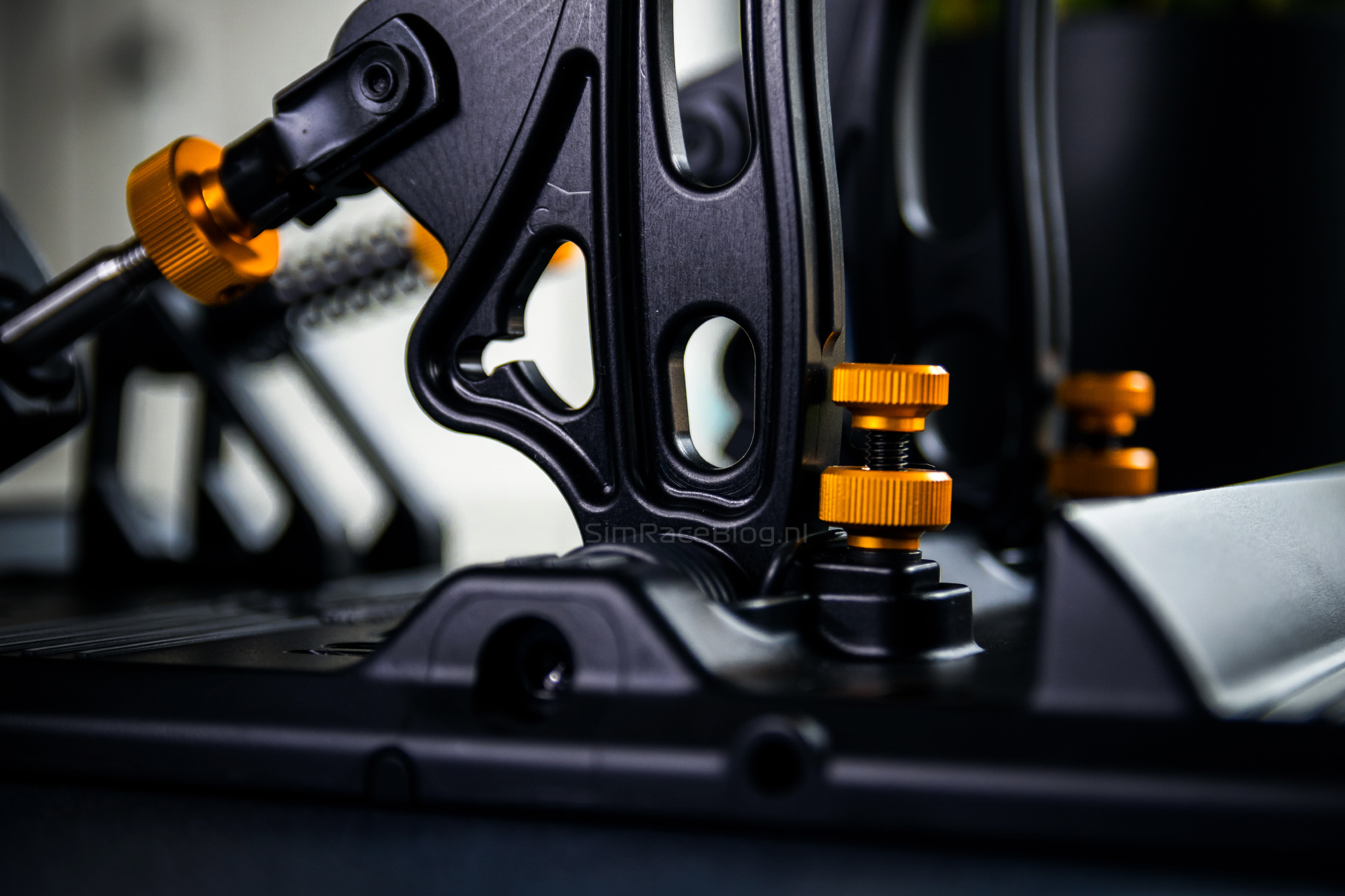


Just like the Invicta pedal set, the Pagani Huayra R pedal set can be adjusted entirely without the requirement for tools. The options and methods for adjusting preload on both pedals, the angle, the travel of the brake pedal, and replacing the elastomer in the T.H.O.R.P.™ brake pedal are all identical to those of the Invicta brake pedal. The only difference here is that the footplates of the Pagani Huayra R pedal set are not adjustable.

Mounting
We’re going to mount the Asetek Pagani Huayra R pedal set on one of our FormulaSimRigs Avanzata setups. With the supplied bolts and T-slot nuts, it’s a breeze to place the pedal set on the aluminum profile pedal deck. However, we choose to use our own M6 Ball Spring T-slot nuts instead of the supplied ones with a spring-loaded plate on the bottom, because we find them less convenient to use. We place the nuts, position the pedal set, and tighten the bolts. Well, three out of four bolts, at least, because the fourth one is hidden under the spring mechanism of the throttle pedal. With some maneuvering, it’s reachable with an Allen key, but it’s easiest to remove the spring mechanism to access it properly. This is done quickly, but unfortunately, we don’t find it ideal. The manual mentions this issue nicely, though, so fortunately, we don’t have to figure out how on our own.


Software
The Pagani Huayra R pedal set is controlled through the Asetek RaceHub software, which can be downloaded from the Asetek website and which we already have installed on our system. The installation process is straightforward; plug in the cable and launch RaceHub. The pedals are immediately recognized and ready for use.
We open RaceHub and click on ‘Pedals’ in the left menu. Immediately, we initially noticed an image of the Pagani Huayra R pedal set, but after updating to RaceHub 3.0 we see a placeholder image. In the title next to the two tabs that appear, we see the Huayra R logo. We are automatically directed to the ‘Calibration’ tab, where on the right side, we see the options to calibrate the brake and throttle pedals. The input is indicated by a meter that fills up as the pedal is depressed. Below, there is the ‘Calibrate’ button to calibrate the pedals individually and adjust the dead zones. This is all quite straightforward and self-explanatory. What’s interesting about calibrating the brake pedal is that we can see in real-time how much fluid pressure we are building up when pressing the pedal. Even after calibration, the configured value appears above the input meter. This is useful when you want to recalibrate the pedal and want to know how much pressure it’s currently calibrated to. On the other hand, you can also see in real-time how much pressure you’re exerting when modulating the brake pedal, allowing you to quickly adjust how much harder or softer you want it to be.
On the ‘Pedal Maps’ tab, we can adjust the curves of the pedals, determining their response. Here, we can set whether we want a linear, progressive, or regressive response from our pedals. In simple terms, this means we can adjust whether, for example, we want the beginning of the brake pedal to be more or less sensitive compared to the rest of the pedal. We can be as creative as we want here, and the operation of the feature itself is very easy and intuitive.


In the menu on the left, we find a separate page called ‘LED’, which is quite self-explanatory. Here, we can adjust the color of the LED strip on the baseplate of the pedal, among other things. On the ‘Static Color’ tab, we can select the exact color we want using a color wheel and adjust its brightness. Not satisfied? Then there’s the ‘Default Color’ button to restore the color to the original orange color supplied by Asetek. On the ‘Assists’ and ‘Flags’ tabs, we can illuminate the Asetek LEDs depending on the data on the track of your sim. At ‘Brightness’, we can adjust the brightness, and at ‘Idle Mode’, we can adjust the behavior of all Asetek LEDs when idle, i.e., when no sim is running.
Altogether, the Asetek RaceHub software is clear, straightforward, and easy to use. We start by simply calibrating the brake pedal and are then ready to move on to testing the Pagani Huayra R pedal set!


Using the Asetek Pagani Huayra R Pedal Set
We’re going to test the Asetek Pagani Huayra R pedal set first in Assetto Corsa, where we’ll be driving the virtual Pagani Huayra R, which in this case is a mod. The initial impression is familiar, and in two ways. Firstly, because we already have experience with the Asetek Invicta pedal set. At the same time, the pedal set feels familiar because the pedal feel quickly feels comfortable and predictable to us, even from a neutral perspective. The throttle pedal is wonderfully smooth and responsive, neither too light nor too heavy, with a firm and pleasant metal-on-metal end stop. The brake pedal, which comes equipped with the medium-hard elastomer as standard, feels good. We do feel a slight play when we place our foot on the footplate, but we can quickly resolve this by adjusting the angle of the pedal by just a degree and tightening everything securely again. We feel a short, light build-up on the pedal, simulating the distance between the brake pad and brake disc, after which the brake pedal feels nice and firm with minimal noticeable travel. As mentioned, we quickly feel comfortable using the Asetek Pagani Huayra R pedal set. Modulating both the throttle and brake pedals quickly feels comfortable, allowing us to quickly and consistently get around the track.
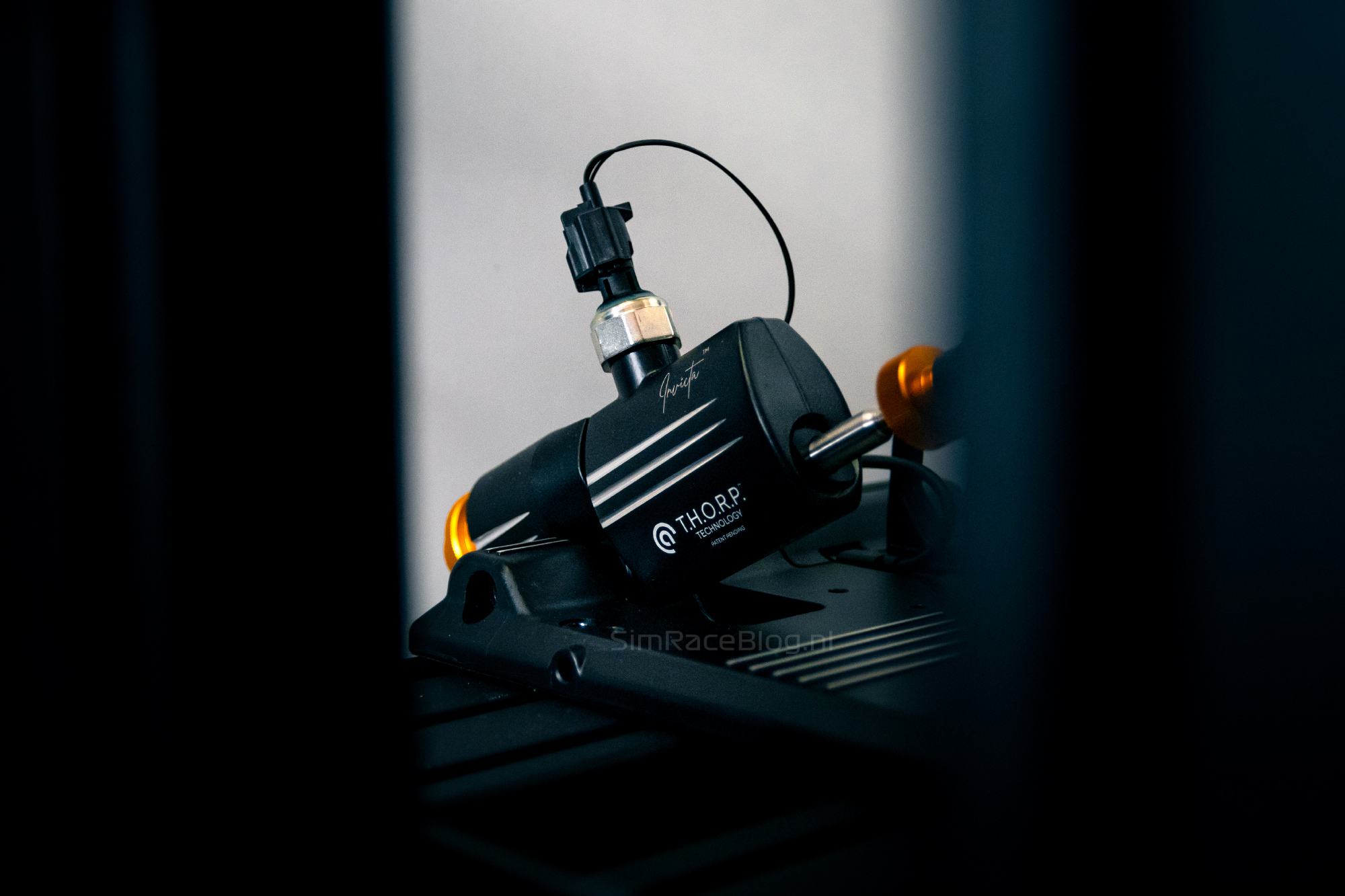

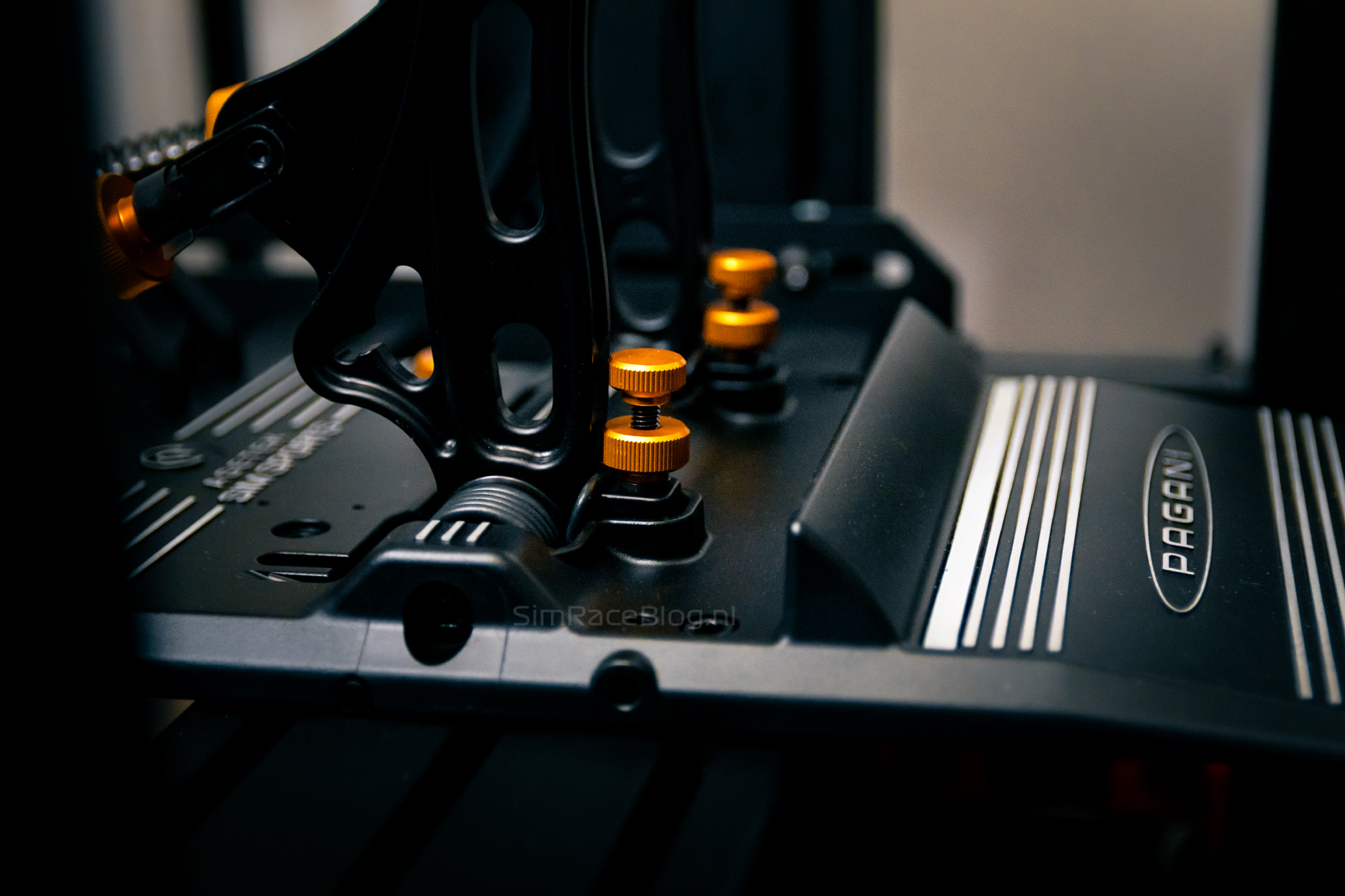
After completing a bunch of laps, we proceed to further adjust the pedal set, which can be done entirely without tools. The manual is very detailed in this regard, with Asetek providing ample reasoning for many choices made, and offering additional information on why you might want to make certain adjustments. Adjusting the throttle pedal travel takes just a few seconds by loosening the locking nut, turning the bolt that determines the end clockwise or counter-clockwise, and then tightening the locking nut again. The same process applies to adjusting the tension of the throttle pedal spring, although in this case, there are two adjusting nuts, one to adjust the tension of the spring and the other to hold the first nut in place. Replacing the spring is just as easy by removing the locking pin, detaching the throttle pedal shaft from the arm, and removing it from the tumbling end stop. Now, we can simply replace the spring with the lighter one and reattach the shaft. The simplicity of this process remains admirable. Personally, we find the lighter spring to feel too light under our foot, so we decide to switch back to the heavier spring that Asetek specifically selected for use in the Pagani Huayra R pedal set after testing the lighter one.


Adjusting the brake pedal is even easier than the throttle pedal. At the end of the T.H.O.R.P.™ module, there are two rings that allow us to adjust the distance between the brake pads and the disc, essentially creating or eliminating preload on the brake pedal elastomer. The outer ring is the locking ring, and the inner one is the actual ring that pushes against the elastomer for more or less tension. We loosen the outer locking ring and can then turn the inner ring outward to reduce the preload on the elastomer, thus simulating a greater distance feel between the brake pad and the disc, or inward to eliminate it and engage the elastomer immediately. To replace the elastomer, we simply unscrew both rings completely from the T.H.O.R.P.™ module, and then remove the elastomer and replace it with a different one. After that, we place the rings back and adjust the preload, and we’re good to go.
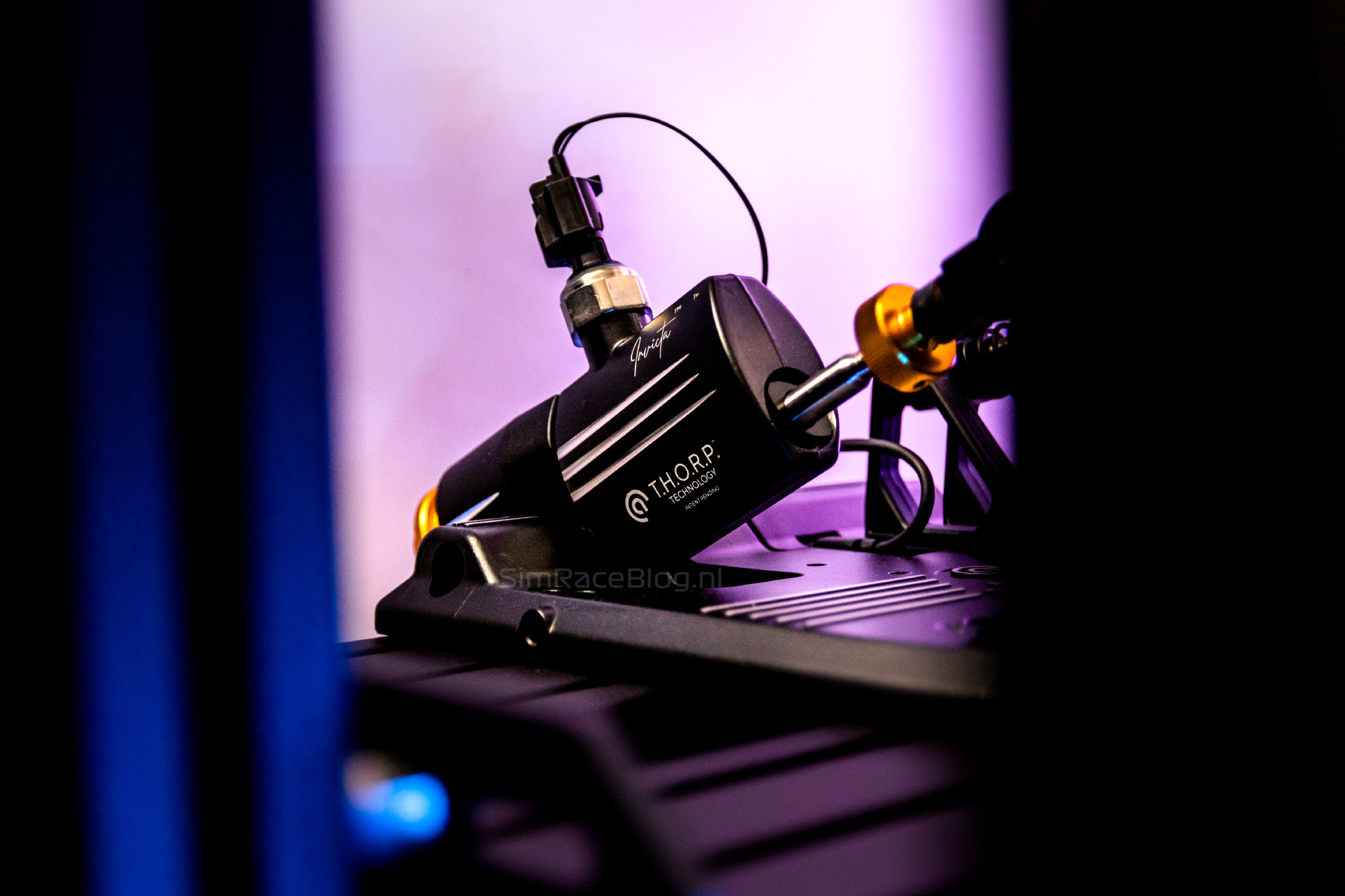


With the Pagani Huayra R pedal set, Asetek provides a softer and a harder elastomer. We first test the softer one. With the softer elastomer, we feel that there is slightly more travel present on the brake pedal when braking. Compared to other pedal sets, however, it still remains a very firm brake pedal, meaning that even at the lightest setting, it may not necessarily be suitable for sim racers who prefer to feel a lot of travel on their brake pedal or who want to mimic the brake pedal of a street car. When we install the hardest elastomer, we notice the opposite effect: almost all of the travel is eliminated, and the brake pedal feels as hard as a brick. This makes it easy for us to focus solely on the amount of force we apply to the brake pedal to create muscle memory, without relying on how far we depress the pedal. For sim racers, for example, looking to mimic a formula car with an extremely firm brake pedal, this is an option to consider.


During our testing and driving with the Asetek Pagani Huayra R, we didn’t encounter any notable issues, though our familiarity with the Invicta pedal set, on which it is based, certainly facilitated the experience. One aspect we found somewhat challenging is the lack of adjustability in the footplates. While we appreciate Asetek’s commitment to replicating the feel of the real Pagani Huayra R pedals, the fixed position poses difficulties, especially for those with smaller feet. The brake pedal, in particular, sits quite high, increasing the likelihood of only braking with your toes, or your foot hovering in front of the pedal, which can hinder consistency and muscle memory development. Although the throttle pedal’s footplate is relatively accessible in terms of height, its narrow shape and raised edge might not provide the most comfortable experience for sim racers who prefer to drive with socks. Despite these considerations, no significant drawbacks detracted from the overall performance of the pedal set during our testing.


Conclusion
It’s no secret that Asetek likes to forge its own path, occasionally causing ripples in the sim racing market. With the Pagani Huayra R pedal set, they’ve introduced a rather unconventional product to the sim racing scene. Based on the Invicta pedal set, this new offering shares many similarities with its predecessor.
Fundamentally, the Pagani Huayra R pedal set is much like the Invicta pedals we’re familiar with: robustly built, crafted from high-quality materials, integrating pedal and baseplate together seamlessly, and being adjustable without the need for tools. What sets the Pagani Huayra R pedals apart are its unique footplates and their height, the inclusion of Pagani branding on the baseplate and foot plate, and the pedal feel specifically tuned to mimic that of the real Pagani Huayra R.
Asetek always delivers when it comes to packaging, and assembly is relatively straightforward. However, it’s a bit of a downside that we have to remove the axle of the throttle pedal for assembly. In use, the throttle pedal feels wonderfully smooth with a firm end stop. Adjusting it is incredibly easy, and there’s sufficient variety in pedal feel options.
The brake pedal with the T.H.O.R.P.™ brake module, which the Invicta brake pedal is also equipped with, performs admirably. The brake pedal, even with the softest elastomer, can be described as very firm. With the hardest adjustment, the brake pedal feels as hard as a brick. Learning to brake with muscle memory is easily accomplished with this brake pedal. Additionally, adjusting and fine-tuning the brake pedal is incredibly straightforward.
The Pagani Huayra R pedal set doesn’t have any significant drawbacks, but we do need to mention the footplates. They’re not adjustable in any direction, which may be uncomfortable for sim racers with smaller feet, especially since the footplate of the brake pedal sits quite high. The raised edge of the throttle pedal is noticeable while driving but isn’t necessarily a major issue.
Overall, Asetek has once again delivered a stunning pedal set with the Pagani Huayra R pedal set. It remains a variation of the Invicta pedals, but with an iconic look and eccentric character. While the driving experience and adjustability may be comparable to the Invicta pedals, opting for the Pagani Huayra R pedal set brings a uniquely designed sim racing product into your setup that exudes prestige. Especially for true Pagani enthusiasts, this pedal set is a must-have.
Interested in the Asetek Pagani Huayra R pedal set after reading this review? At the time of writing, this eccentric pedal set carries a price tag of €787.49 on the Asetek website.
Do you want to stay informed about SimRaceBlog content, news, announcements and (future) give-aways? Follow us on Instagram @simraceblognl and/or our Discord channel.