Conspit H.AO Hub + Wheelrims
Although Conspit is not yet a well-known name in Europe, they are gradually gaining more presence in the European sim racing market. This Shanghai-based manufacturer offers an impressive range of sim racing hardware, from pedals and rigs to highly professional full-sized Formula cockpits.
Previously, we reviewed the FP-Lite Simrig, the CPP.Lite Hydraulic Pedal Set and the CPP Series pedals for Conspit, and they left a very positive impression on us. So, we were more than excited when Conspit offered us the opportunity to review the latest product in their lineup: the H.AO HUB. We didn’t have to think twice about accepting Conspit’s offer to test this button box along with three different wheelrims.
At the time of writing, the Conspit H.AO is not yet available on the market and has only been announced for pre-sale.
Packaging & Contents
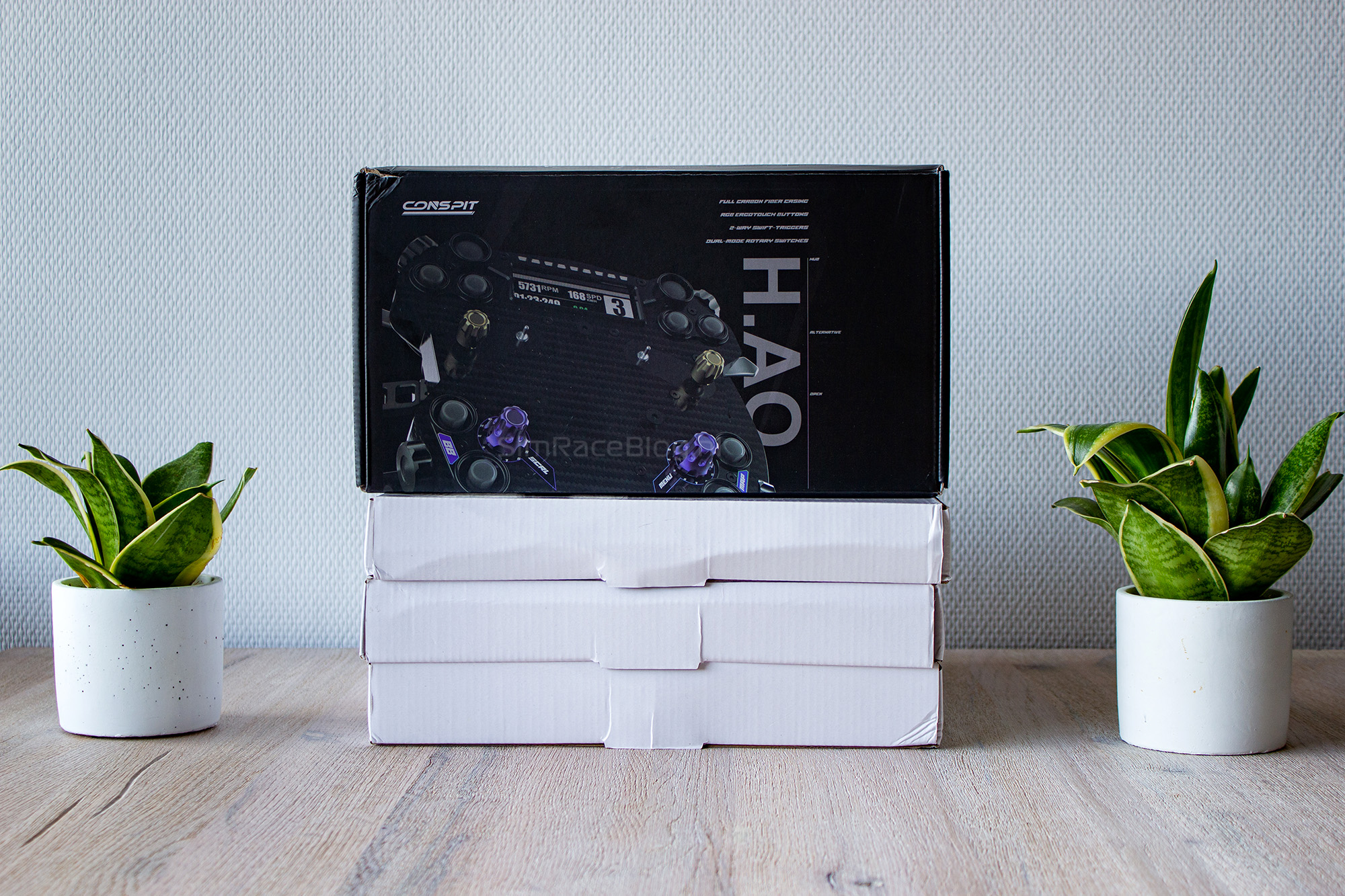
The package traveled from the Far East to the Netherlands in five days and was delivered to our door by UPS. We received a brown outer box sealed with Conspit-branded tape. Inside this box, we found three plain white boxes for the individual steering wheels and one black box for the Conspit H.AO HUB itself. Although the boxes looked neat, it seems they suffered some minor damage during transport.
The Conspit H.AO HUB
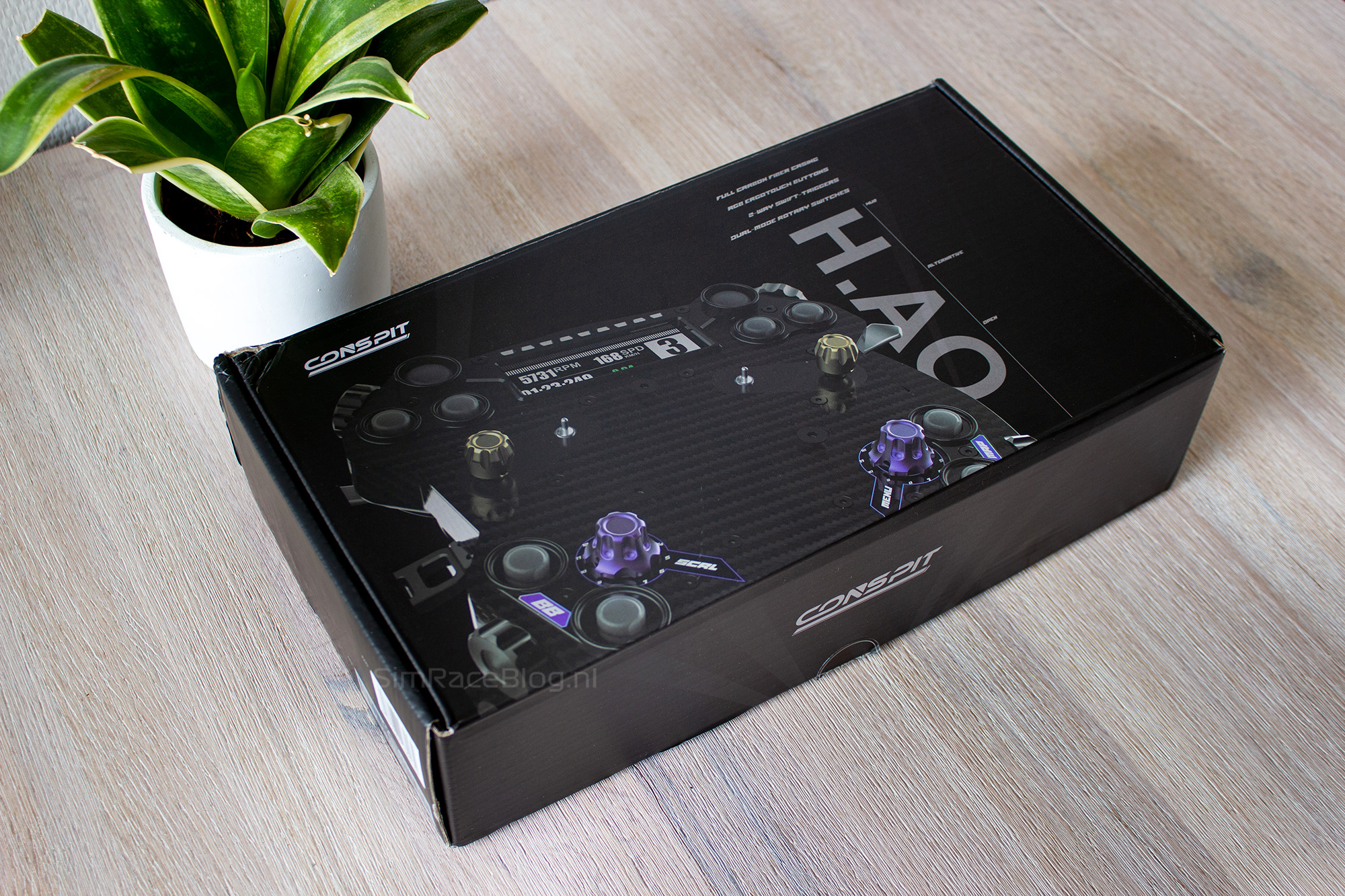
As we mentioned, the Conspit H.AO HUB comes in a black box. It’s a relatively compact box with a nice close-up photo of the product on the top and the necessary specifications on the back. Overall, it’s an attractive box that sparks curiosity and invites us to explore its contents.

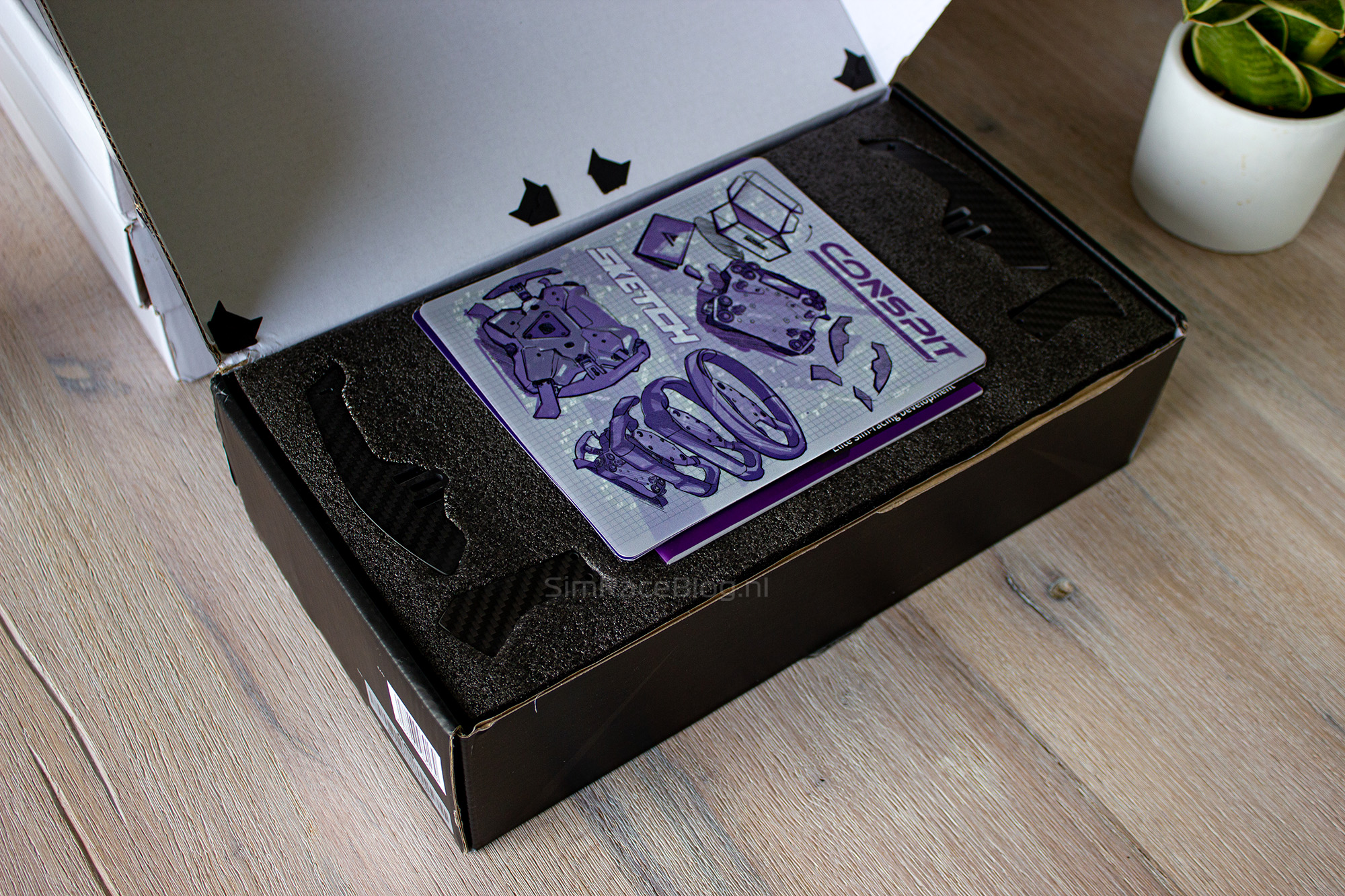
When we open the box, we’re immediately pleasantly surprised, as Conspit has done before. Inside the lid, we find no less than four sheets of stickers and another iconic plastic sheet with some sketches of the product—something we always appreciate when unboxing a Conspit product. In the box, there’s a neat black foam insert with several well-filled cutouts. These hold the carbon shift paddles, carbon clutch paddles, the manual, and a very special-looking tool.


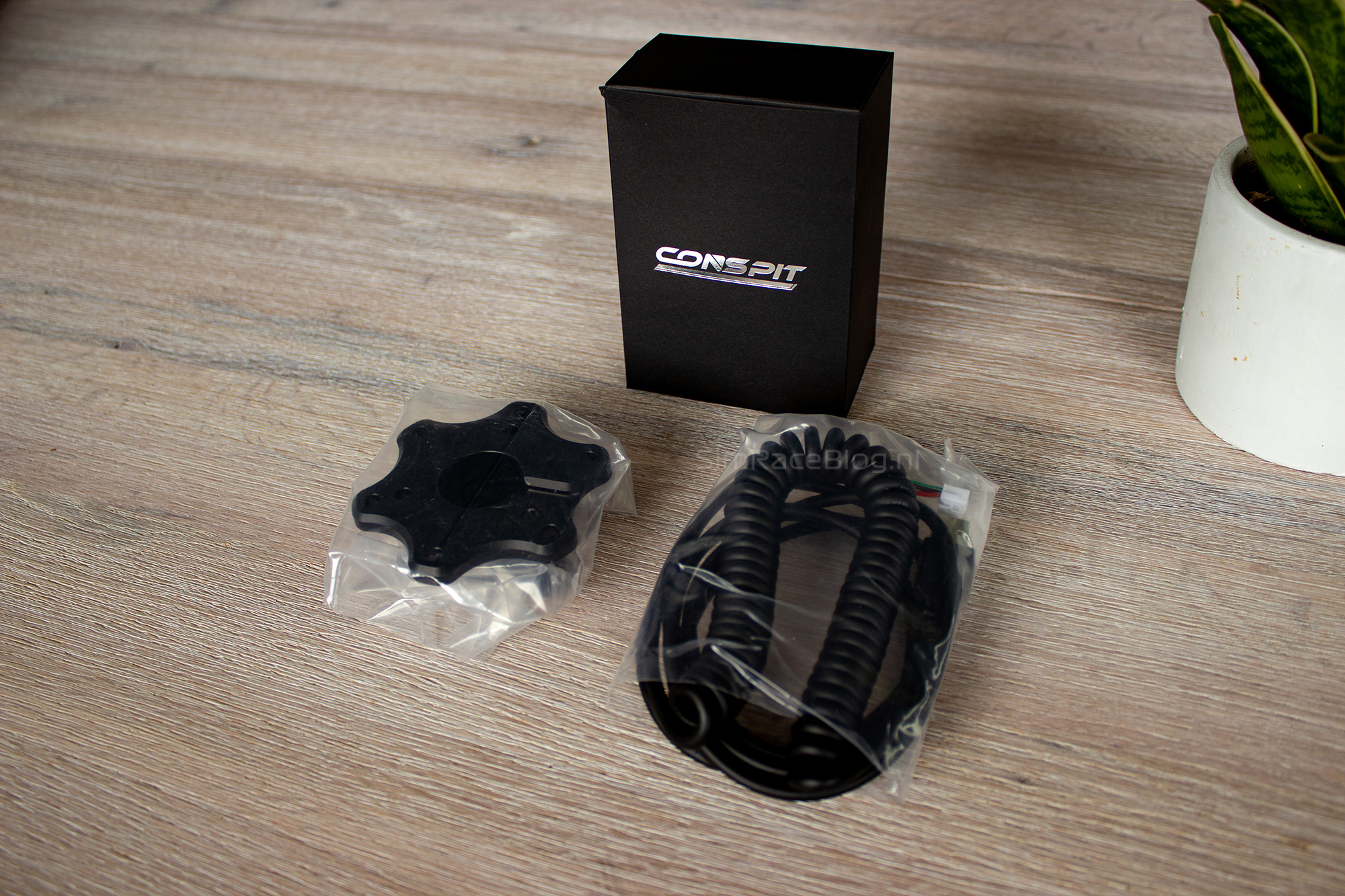
When we remove the top layer, we’re greeted with another beautiful presentation. The first thing that catches our eye is the stunning H.AO HUB itself, nestled snugly in the black protective foam. Next to the hub, there are two matte black boxes with shiny silver Conspit logos, also neatly embedded in the foam. In the larger box, we find a quick-release connector along with a cable that has a plug for the steering wheel on one end and a USB-A connector on the other. The smaller box contains a plastic bag filled with all the mounting materials and tools needed to get started with the H.AO HUB.




The Wheelrims
The boxes of the included wheelrims stand in stark contrast to the box we found the hub in. Compared to the hub box, and even the boxes of the individual steering wheels from competitor Asetek, these boxes are quite dull. The steering wheels are packaged in plain white boxes without any branding or product presentation. On the front of the boxes, in the bottom left corner, there’s a simple sticker indicating which steering wheel is inside, accompanied by a very small picture of the steering wheel itself.



Unfortunately, unpacking these boxes doesn’t feel like a special experience, unlike with the hub. The white boxes open on the short side, and there’s no way to see what we’re unpacking until we reach inside. When we reach in, we pull out a simple protective bag made of thicker, airy white plastic. It’s only when we take the contents of the white bags out that our excitement reignites because in each box, we find nothing less than a beautiful wheel rim that we can attach to the H.AO.
We secretly hope that these boxes are temporary, given that we received these wheel rims at a very early stage, and that in the future, unpacking the wheels will also become a true Conspit experience.

Engineering & Quality
The Conspit H.AO HUB is a button box, a concept we reviewed earlier this year for Asetek as well. A button box is essentially a central input module that incorporates all the input options of a steering wheel. We can then mount various types of wheel rims onto it to create a new wheel. The advantage here is that it allows for relatively inexpensive access to multiple types of steering wheels. We only need to purchase the “expensive” electronics once, and then acquiring a “cheap” wheel rim is sufficient to bring home a completely new type of wheel.
The Conspit H.AO HUB
The central button box of the Conspit H.AO HUB is the core of the product, upon which its success hinges. Conspit makes it clear in every aspect that this button box is crucial, resulting in a seemingly uncompromising design. The foundation of the H.AO HUB consists of a housing made entirely of woven carbon, aiming to emulate the qualities of a real racing wheel. This means it must be lightweight, sturdy, and durable. To keep all the electronics neatly contained, the housing also features a carbon plate at the front to seal the assembly.
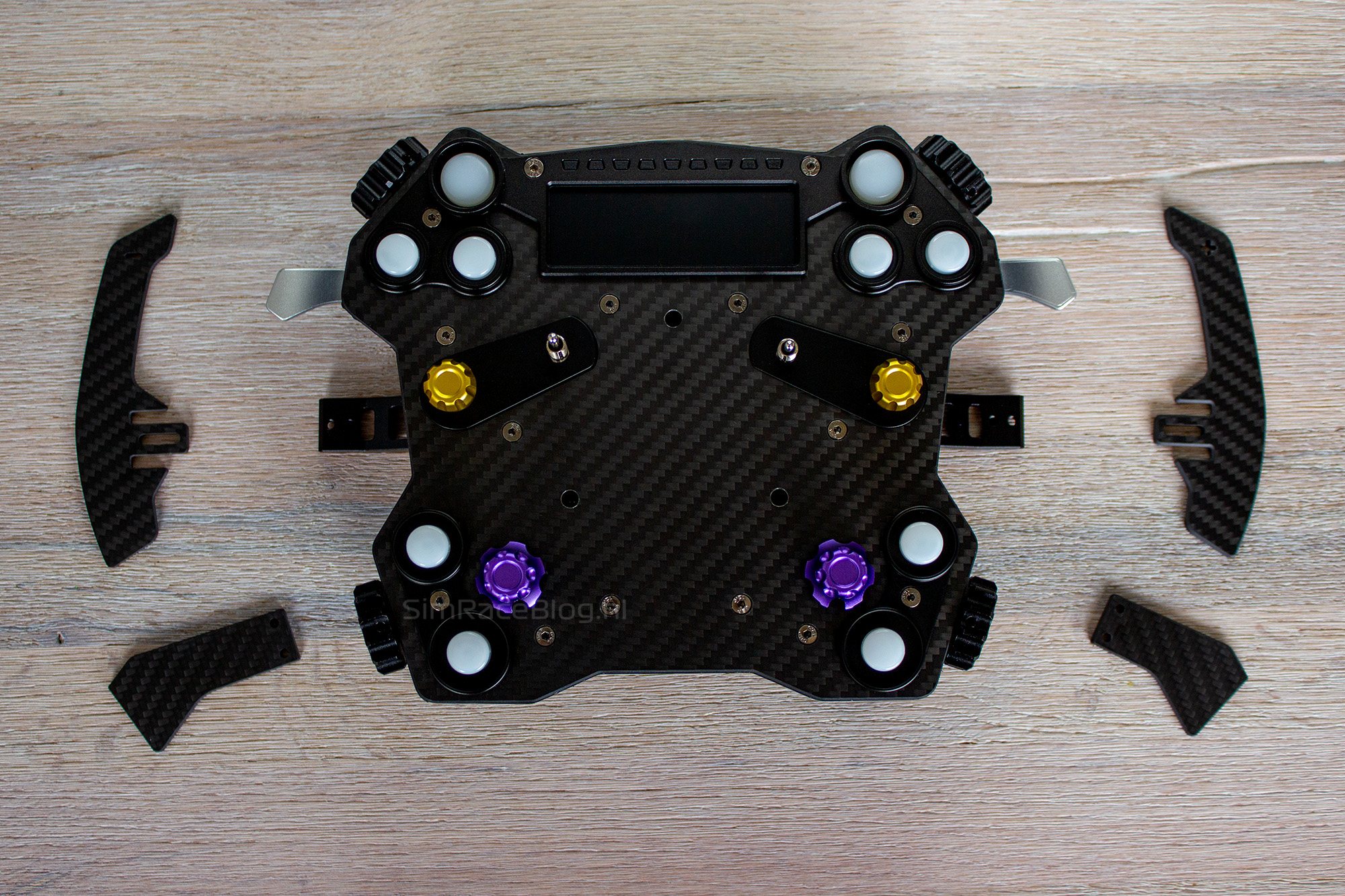
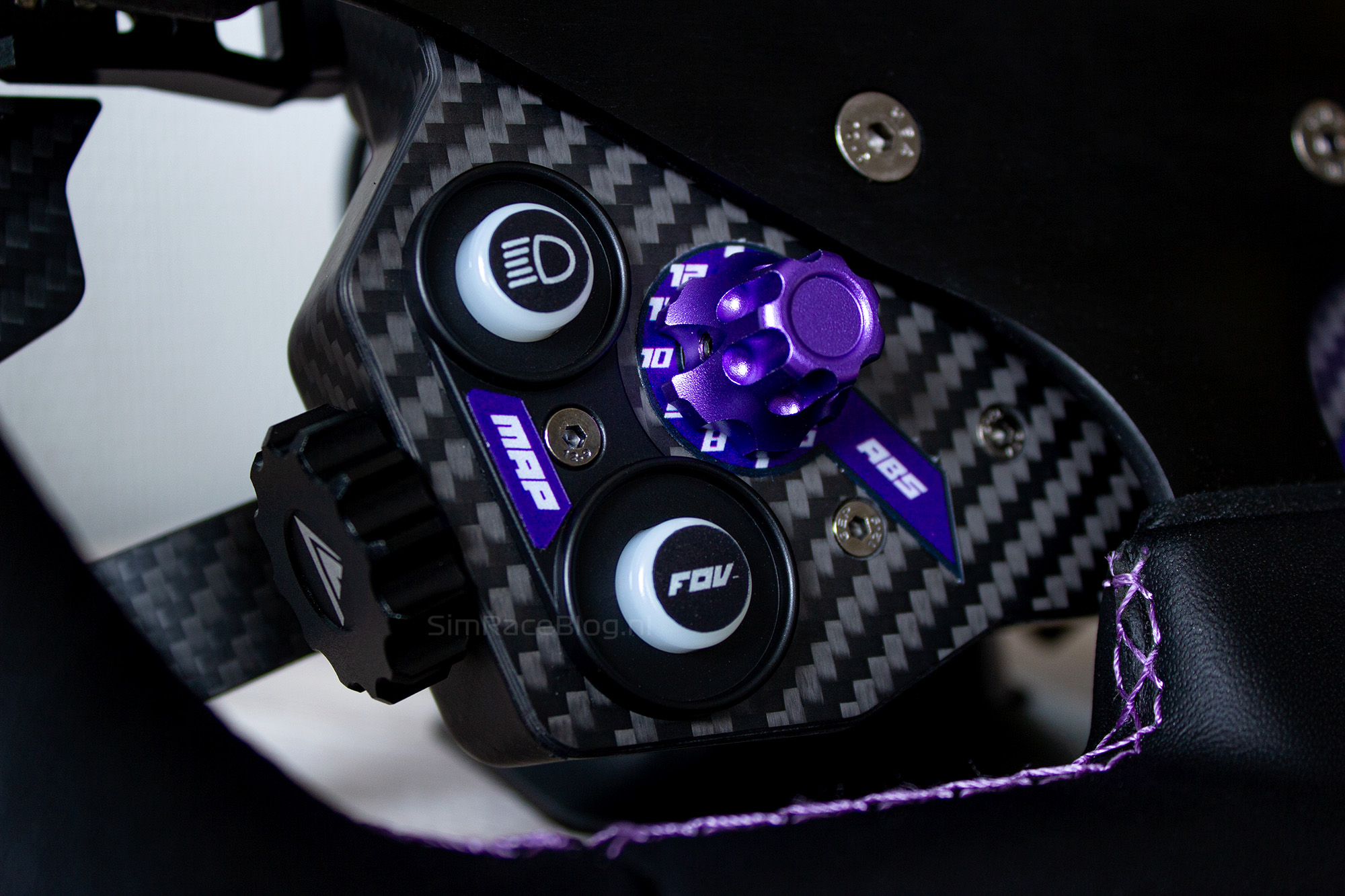
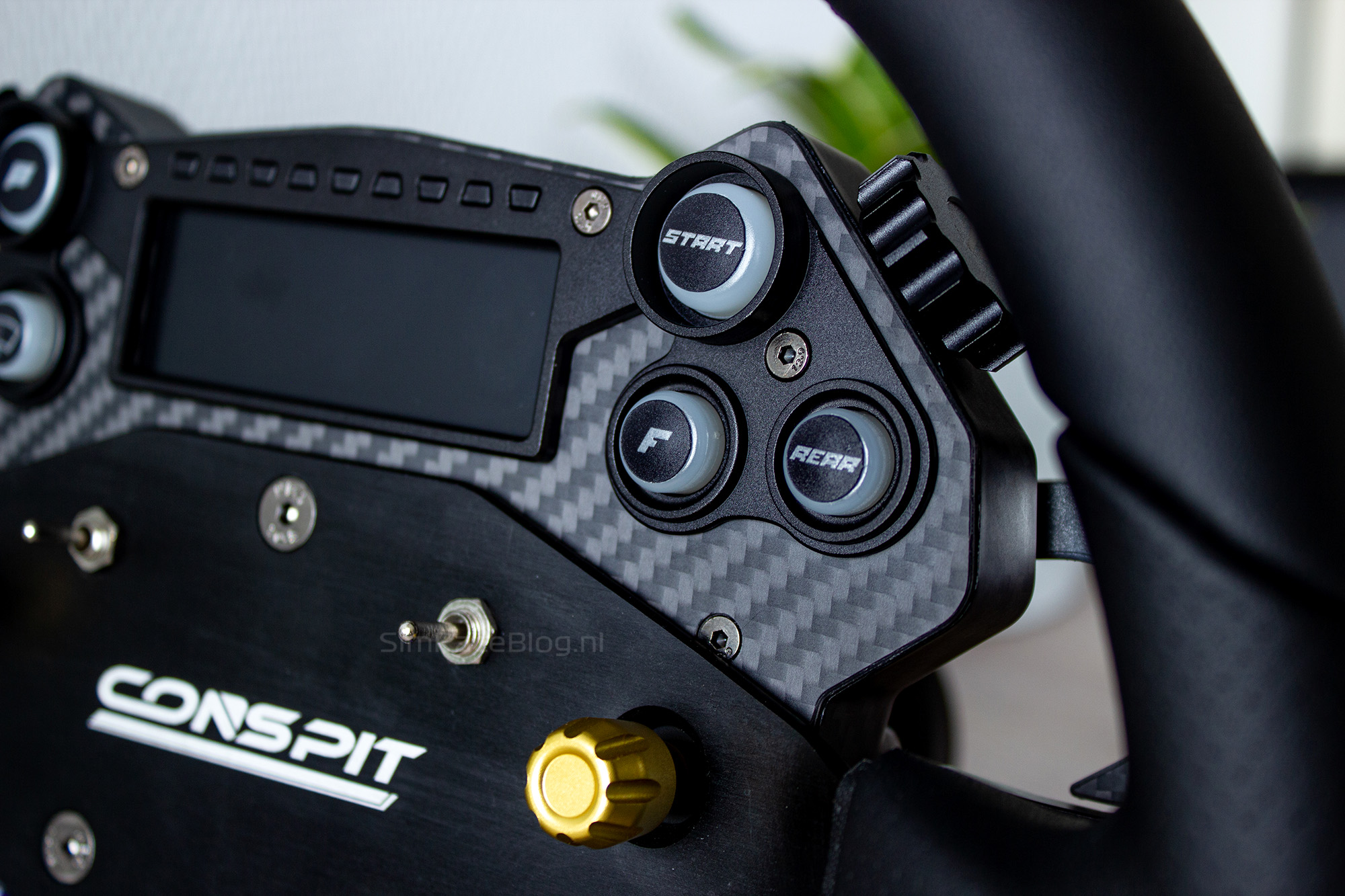
Looking at the front of the button box, we see a well-equipped unit with various input options. In total, there are ten push buttons on the front, each capable of being illuminated by the LED behind it. At the top corners, three of the push buttons are located on each side, with one of the three buttons slightly larger and equipped with a higher protective rim against unintended activation. The remaining four push buttons are found in the bottom corners of the button box, with each side featuring two buttons. However, the button box offers much more than just push buttons. Each corner of the housing features a large thumb encoder, while two purple dual-mode rotary encoders are located at the bottom. Additionally, the button box boasts two 7-way Funky-Switches with gold-plated heads and is completed at the front by two Two-Way-Switches. What’s unique about the Funky-Switches and the Two-Way-Switches is that they are placed on removable magnetic modules, which we’ll further elaborate on in the Assembly section.
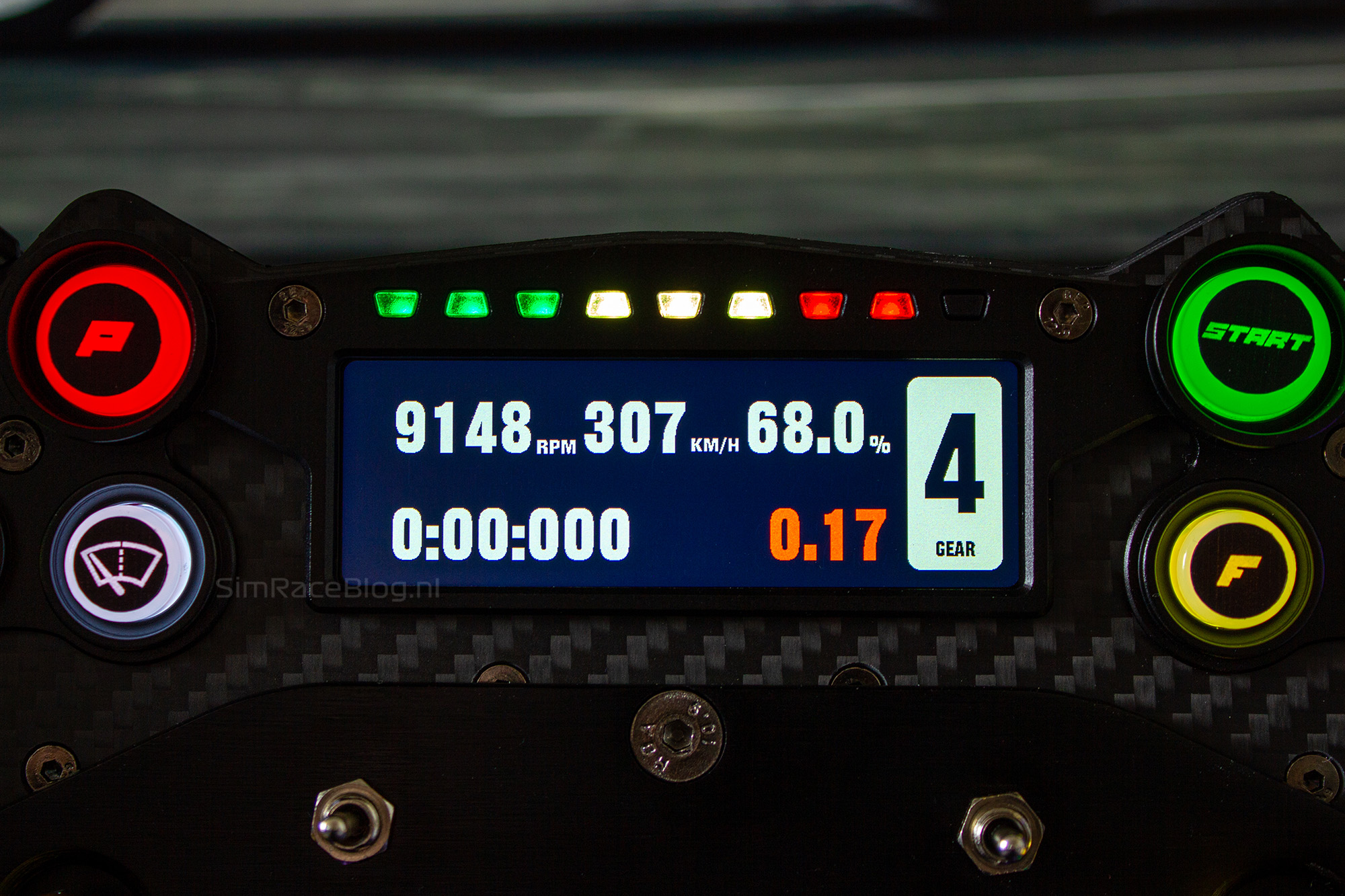
Moreover, the front of the button box doesn’t just feature buttons and encoders; it also provides visual feedback for the driver. In the middle of the top, there’s a 2.99-inch rectangular screen, allowing the driver to select from various dashboards programmed by Conspit while driving. Finally, above this screen, there are nine individual LEDs for displaying the engine RPM.


The back of the button box is just as impressive as the front, with plenty of controls present. Firstly, we must note that the back of the Conspit H.AO HUB, partly due to its full carbon housing, looks truly stunning and resembles a real Formula 1 wheel. The addition of a small metal nameplate on the back adds an extra touch of elegance to the already beautiful ensemble.
Unfortunately, as mentioned, the back is, well, at the back, and we won’t see much of it. More importantly, however, are the controls that Conspit has placed on the back of the button box. The first, and arguably the most important, modules we encounter at the back are the magnetic shifting modules. The functional mechanism of the shift paddles is neatly integrated behind the carbon, with only the arm of the modules protruding outward. The carbon-made paddles can be mounted on these arms, with the left paddle featuring a “-” shaped cutout and the right paddle having a “+” shaped cutout.
Below the shifter modules of the H.AO HUB, there’s also a dual-clutch system placed as standard. Similar to the shifters, only the arms of the module for the clutch are visible, allowing the paddles to be mounted. Conspit has opted for an asymmetric design for the clutch paddles, with one paddle longer than the other, providing users with the option to choose how they are mounted. It’s a small detail that adds a bit more unique customization to the wheel.
The last feature on the back of the button box is perhaps the most remarkable. Above the shift modules are the Swift-Triggers™. The Swift-Triggers™ are two dual-action push-pull levers positioned at the level of our index fingers. This allows for quick operation of a lever with just the index fingers, which can be operated both as a push button and a pull lever. With this setup, we have access to four separate input options “at the tip of our fingers.”


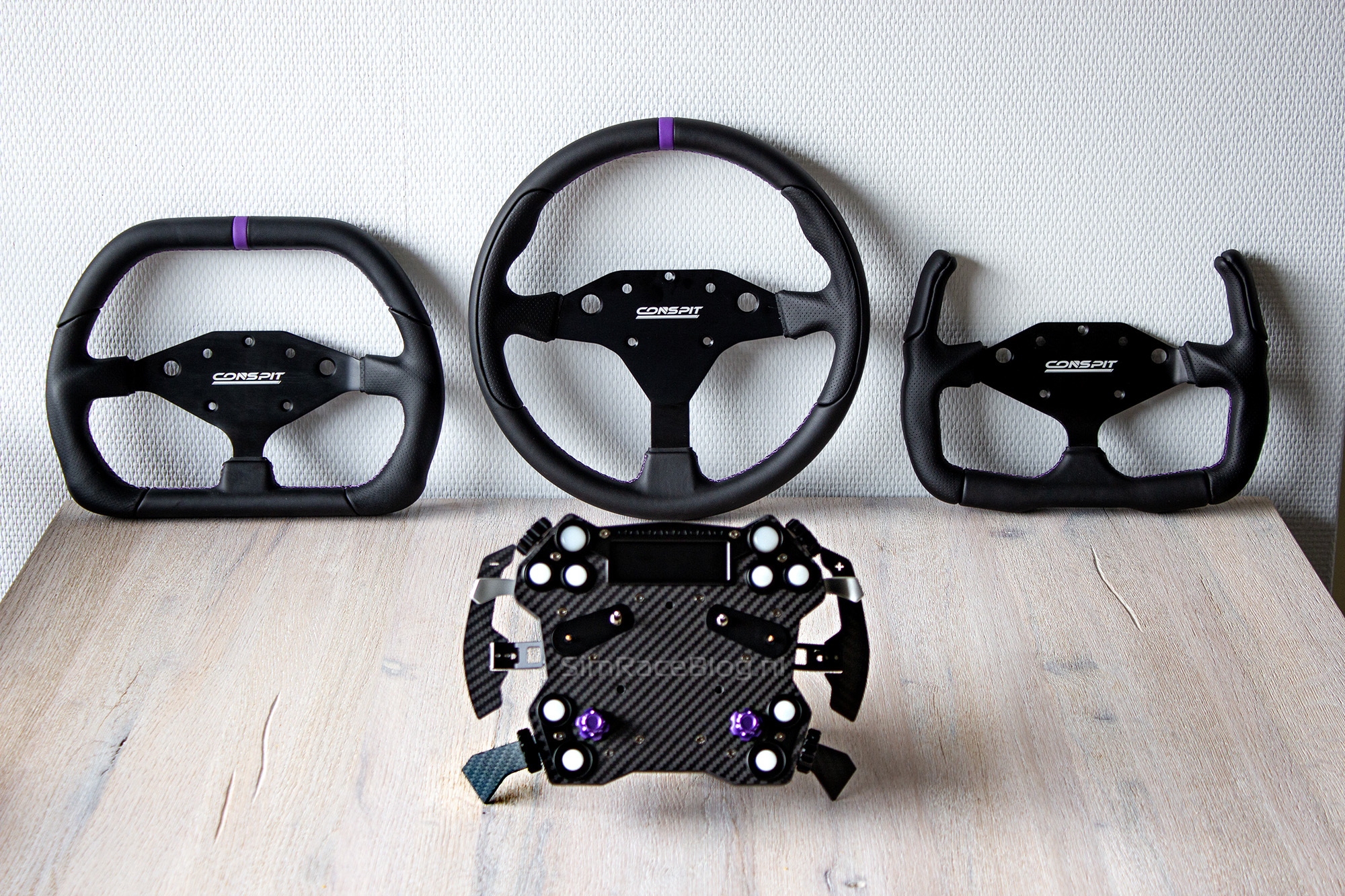
The DX320 Wheel Rim
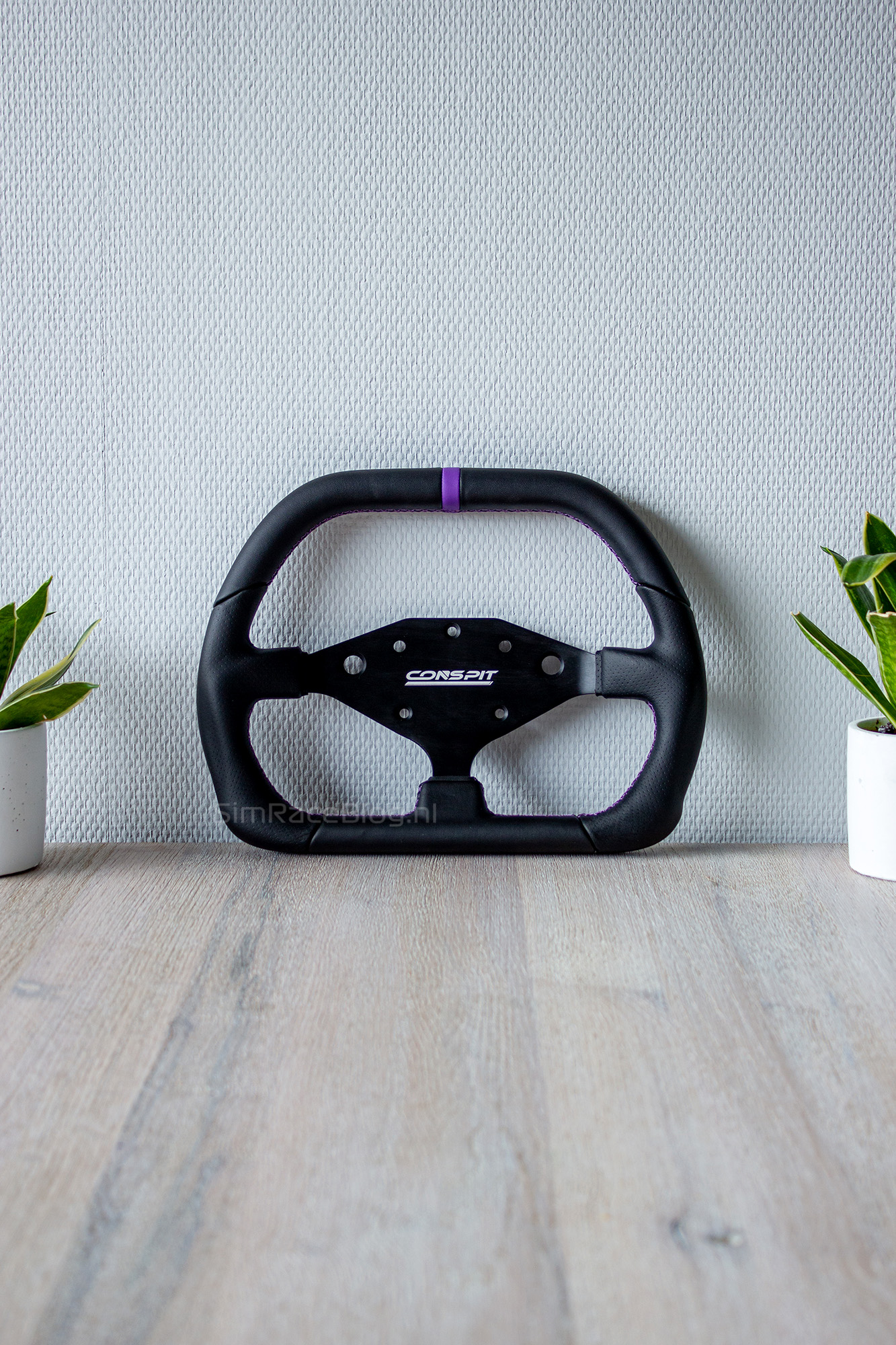
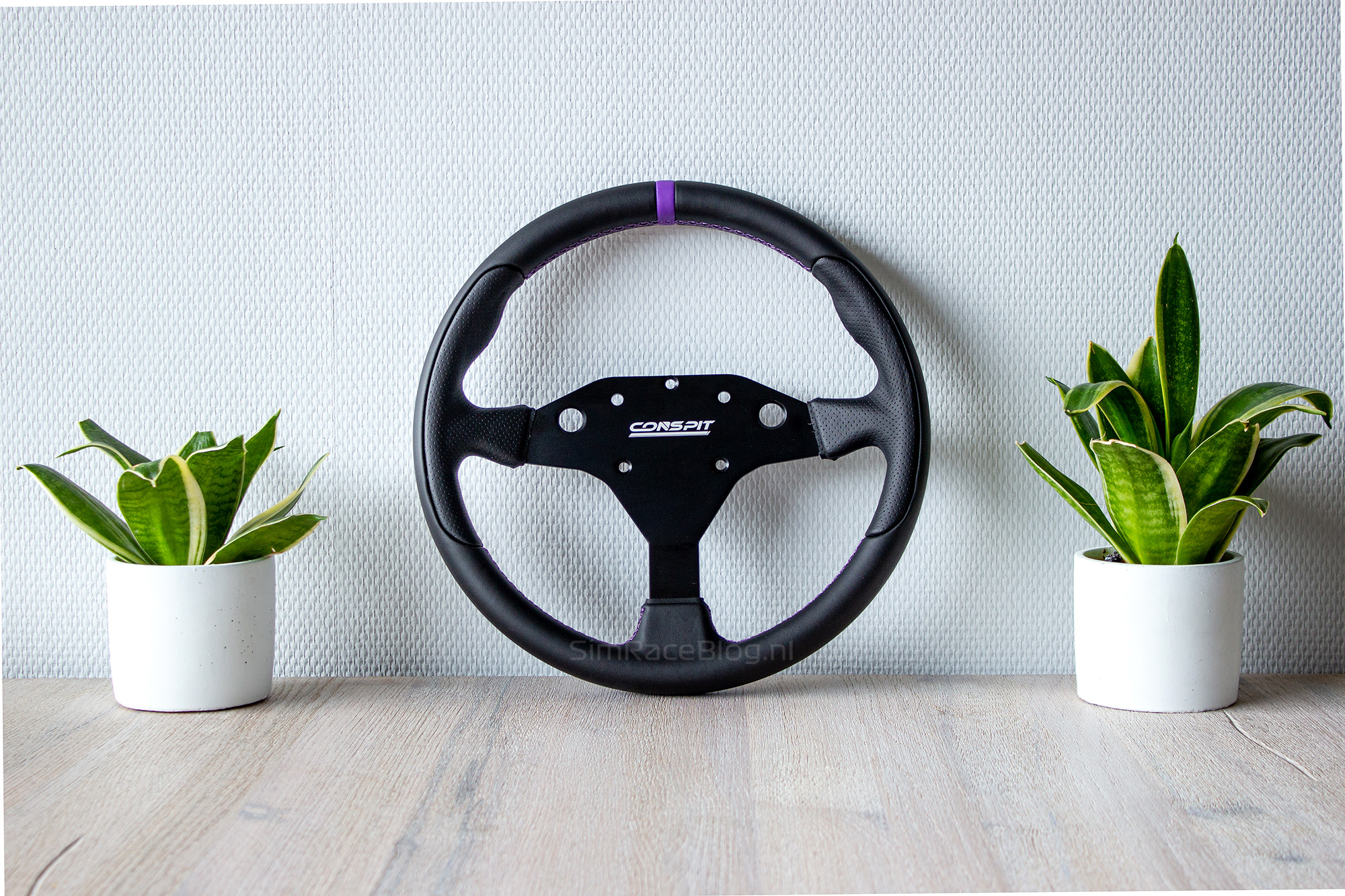
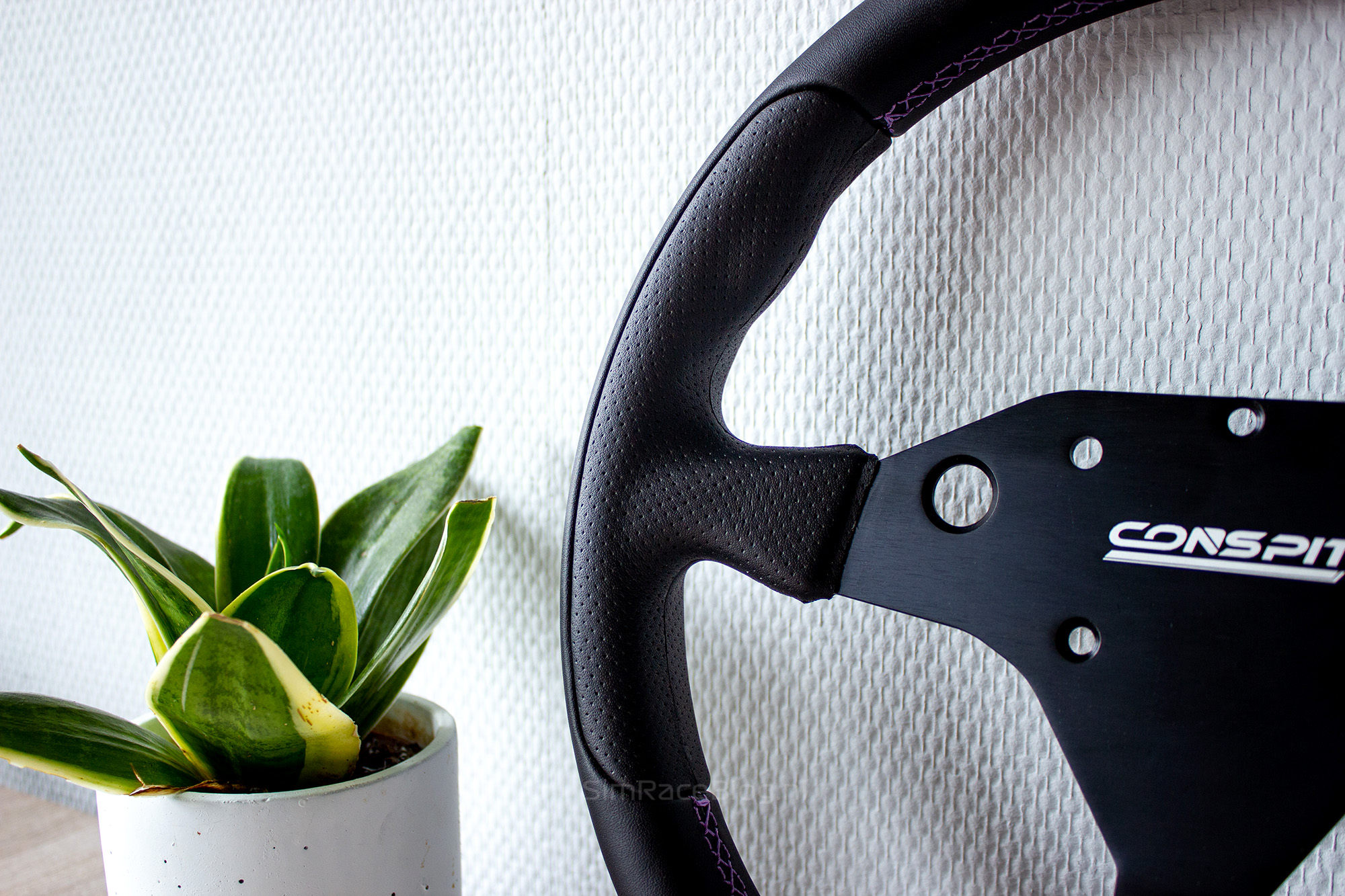
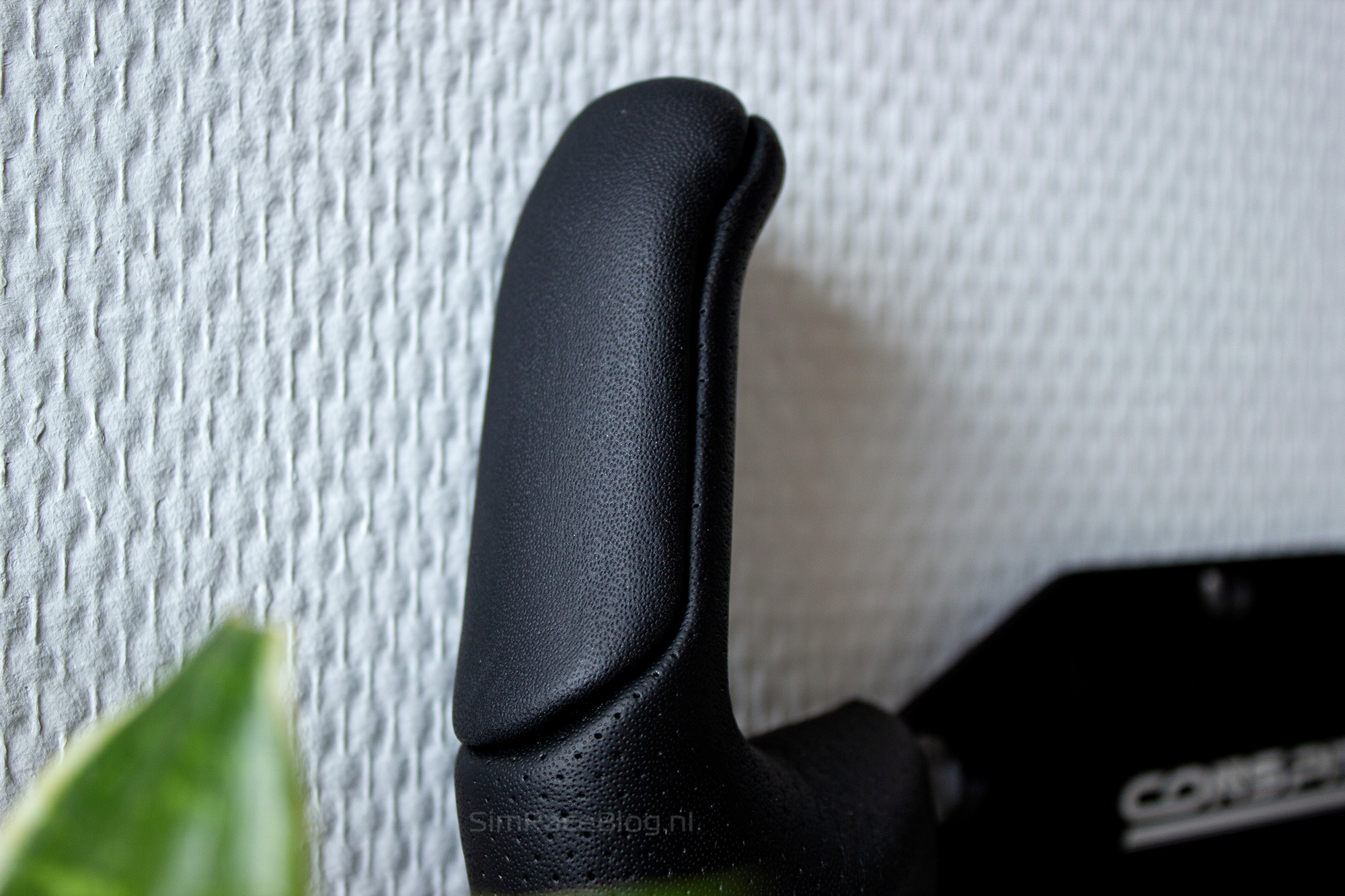
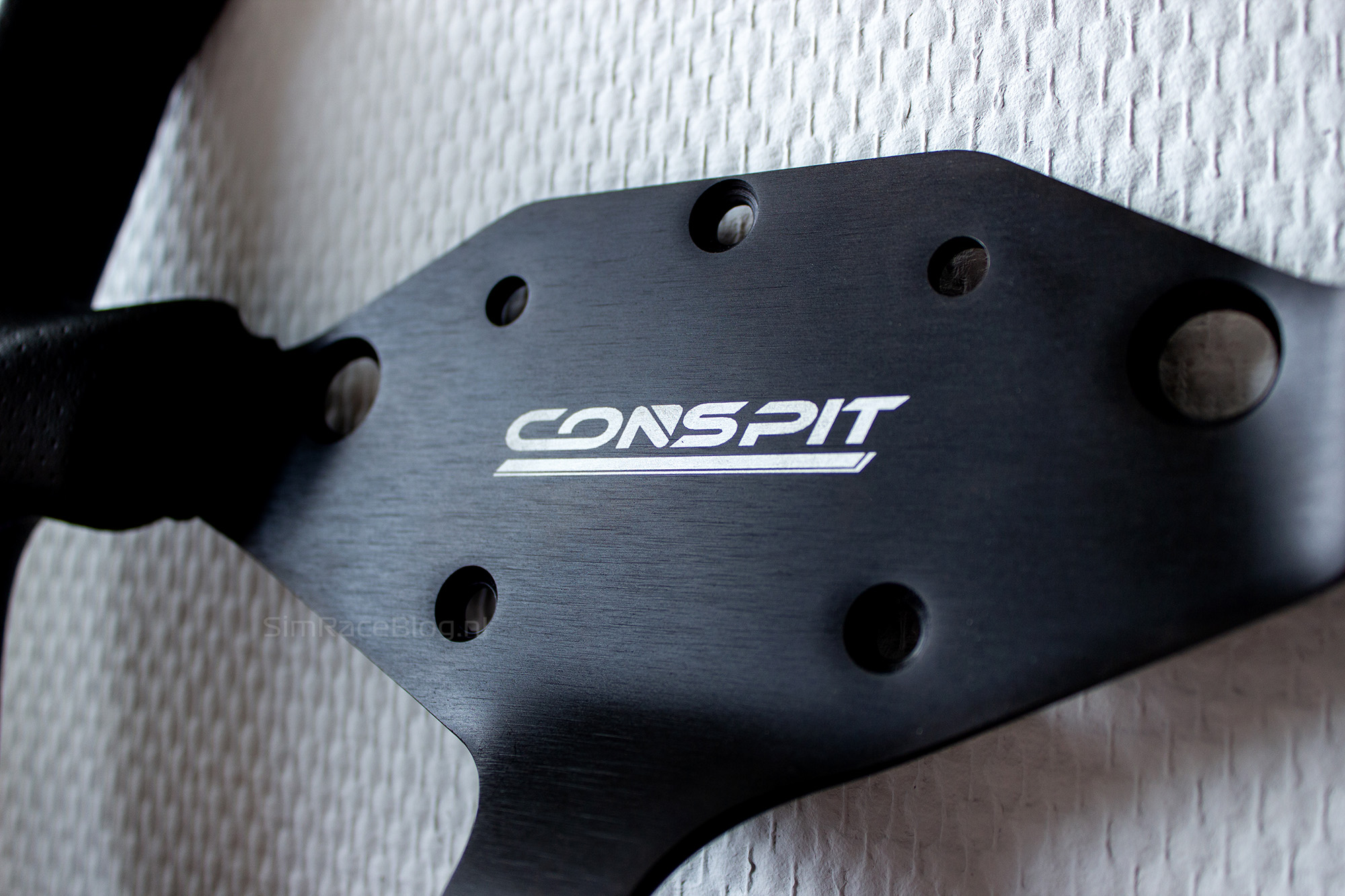
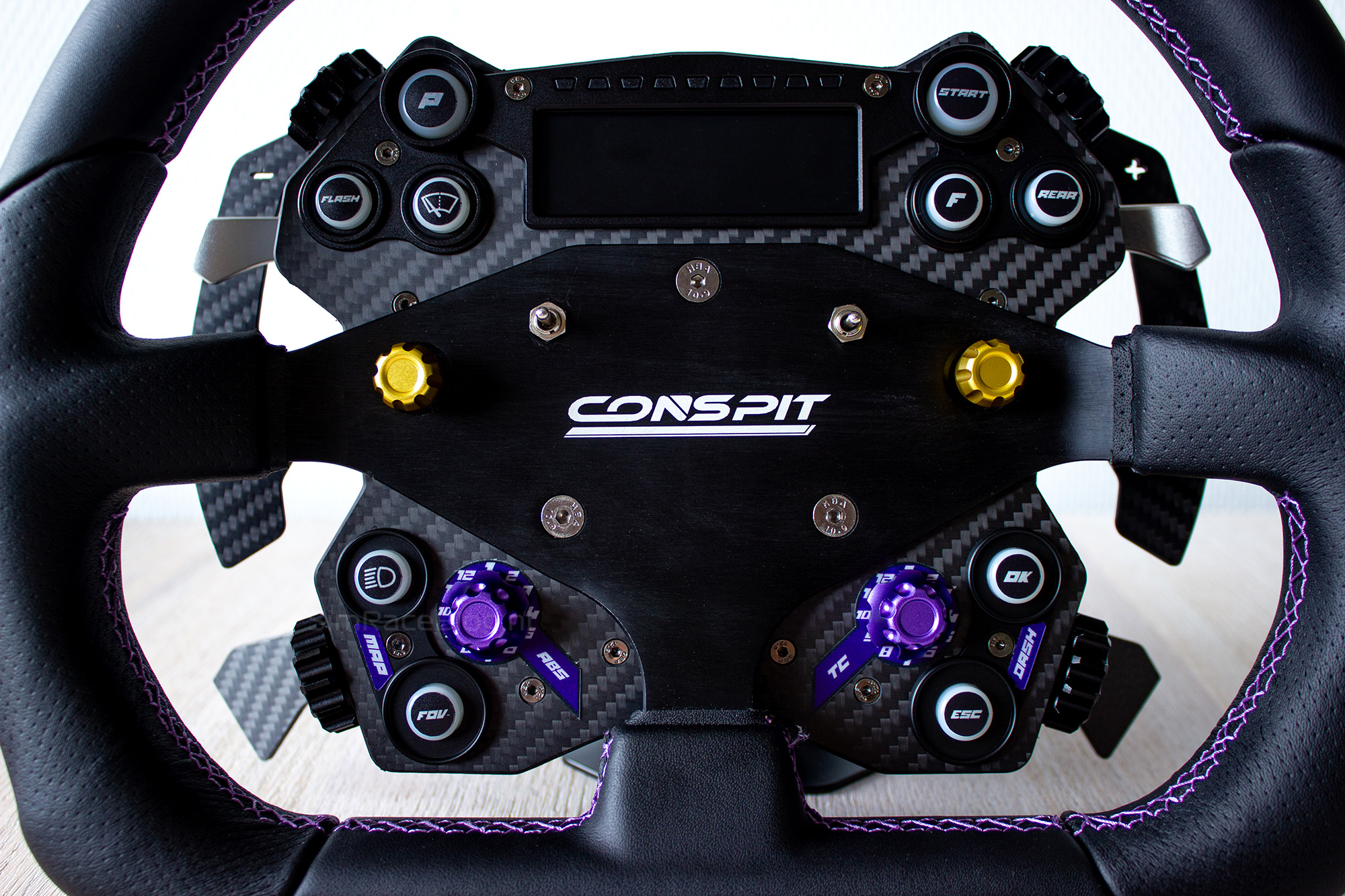
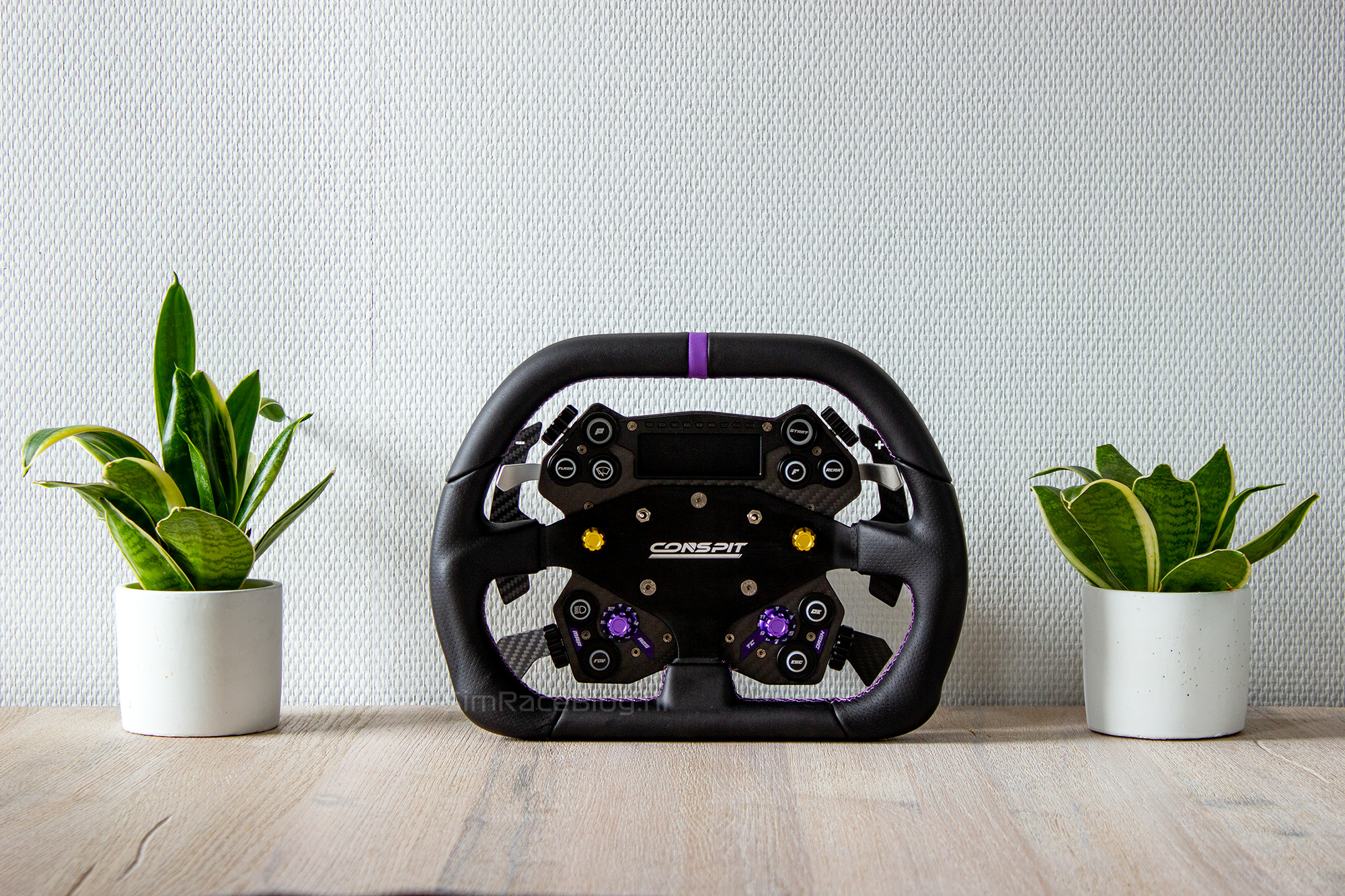
The first standalone wheel rim included with the Conspit H.AO HUB is the DX320 steering wheel. As the name suggests, this is a standalone rim with a D-shape, meaning the bottom is flattened, roughly resembling the shape of the letter “D”. What sets the DX320 steering wheel apart is that the top of the wheel is also flattened, giving it a slightly more aggressive appearance. The 320mm wide steering wheel is entirely covered in sleek-looking synthetic leather, with the actual hand grips of the wheel covered in separate pieces of perforated synthetic leather. At the top of the wheel, we find a neat marking colored entirely in Conspit’s purple branding. But it doesn’t stop there; Conspit has also chosen to use purple stitching to finish off the DX320 steering wheel. The core of the steering wheel consists of a 3.5mm thick black anodized aluminum plate, which protrudes slightly forward at the connection points with the outer rim. This plate features a total of seven holes, with three countersunk holes used for attachment to the button box, two for the passage of the Funky-Switches, and the last two serving as passages for the two-way switches. As the final touch, the center of the steering wheel is adorned with white Conspit branding to complete the look.



The RX320 Wheel Rim
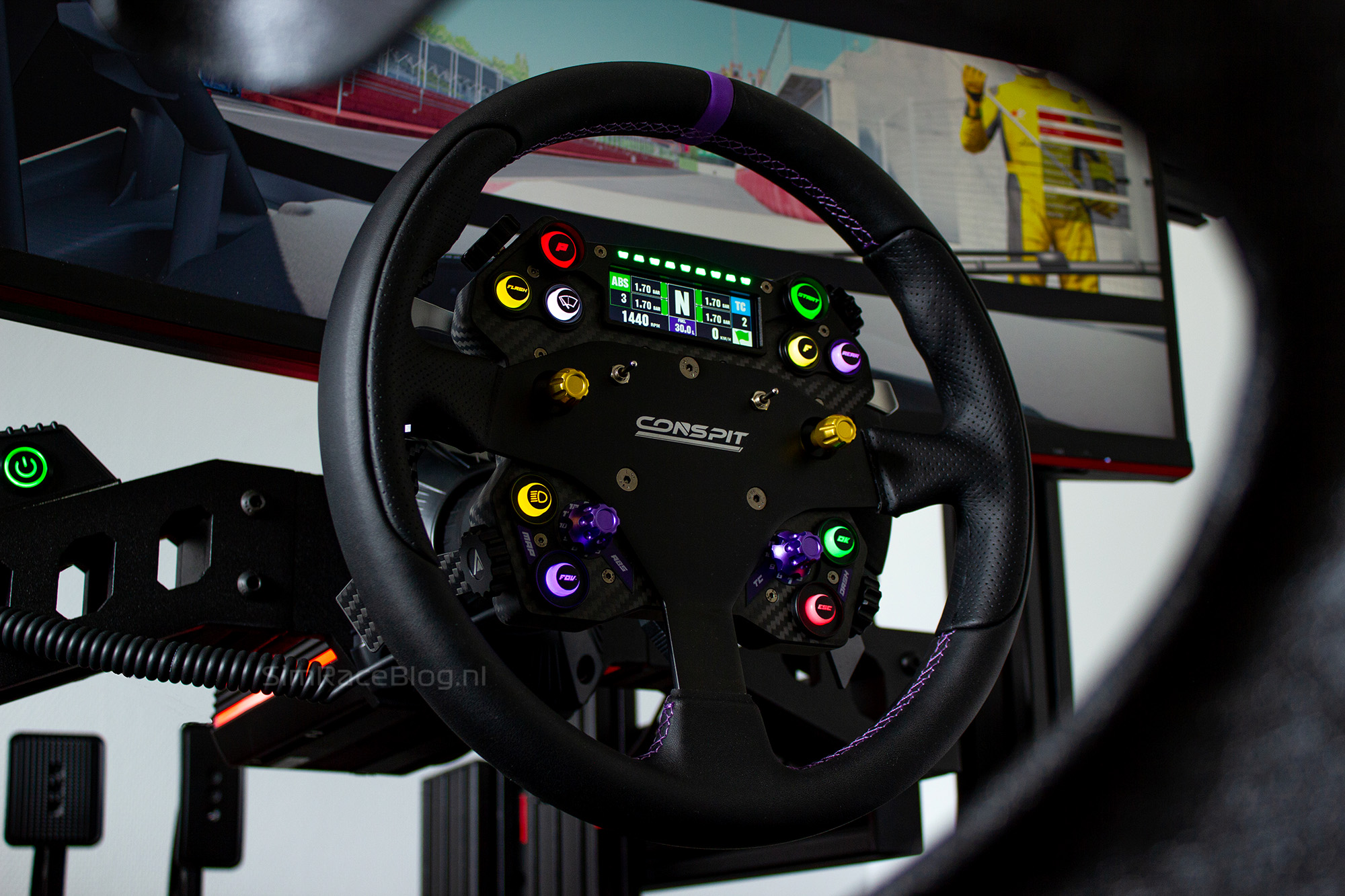
The RX320 wheel rim, like its sibling, is a 320mm diameter wheel. The “R” in the name of this wheel stands for “Round,” indicating that it is indeed a round steering wheel. Similar to the DX320, this steering wheel is also covered in synthetic leather. However, it’s noteworthy that the entire wheel is covered with a single piece of leather, with only the inside of the grips featuring the perforated variant, giving the wheel a unique appearance. The round wheel also features purple stitching and a purple top marker. The base plate of the round steering wheel is largely similar to that of the DX320, with the same number of holes and the same black color with a central white logo. One small difference we notice is that the connection points to the wheel rim seem to protrude slightly less forward, giving the center of the wheel a slightly less pronounced depth compared to the rim.



The CX295 Wheel Rim
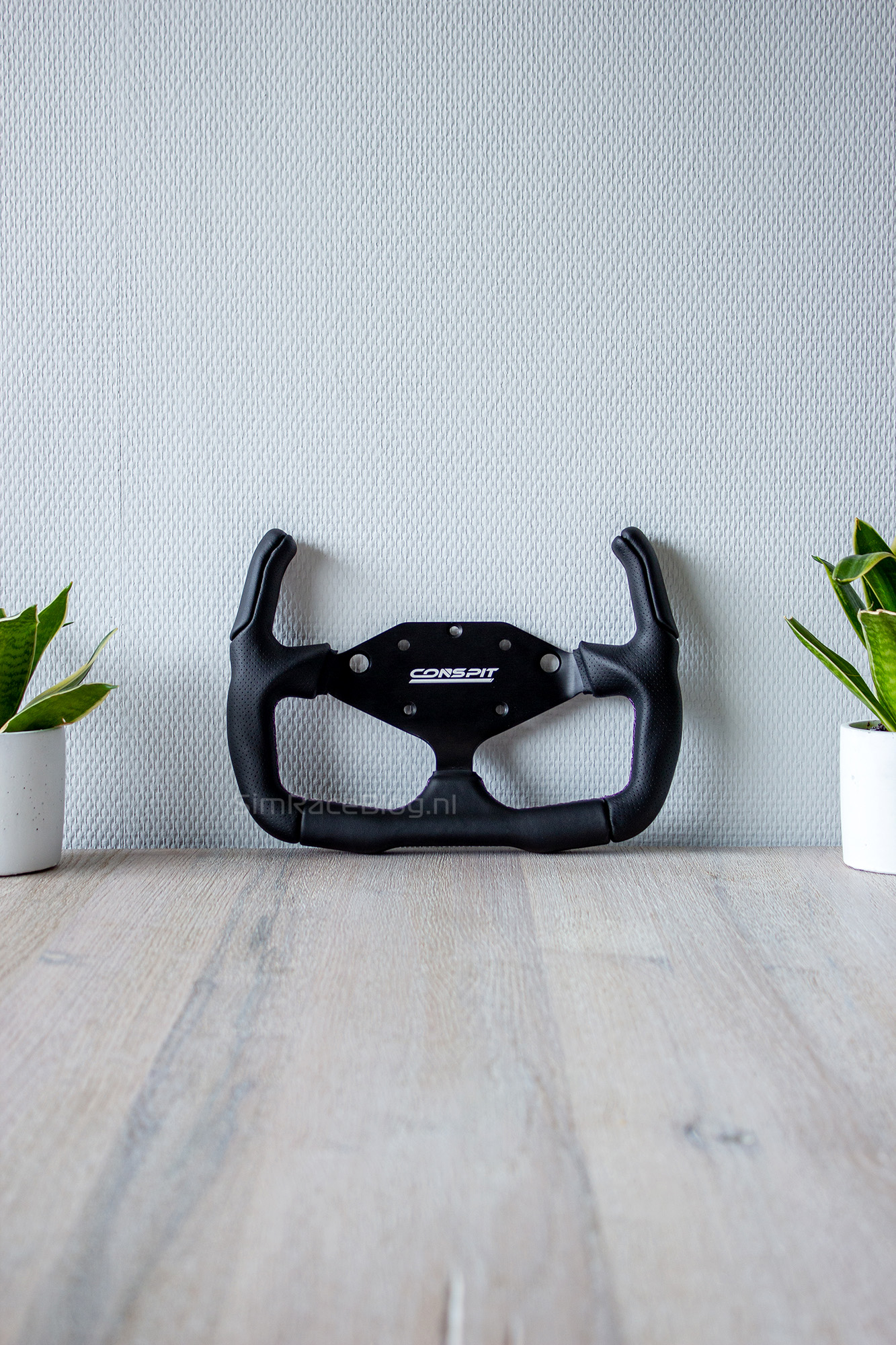
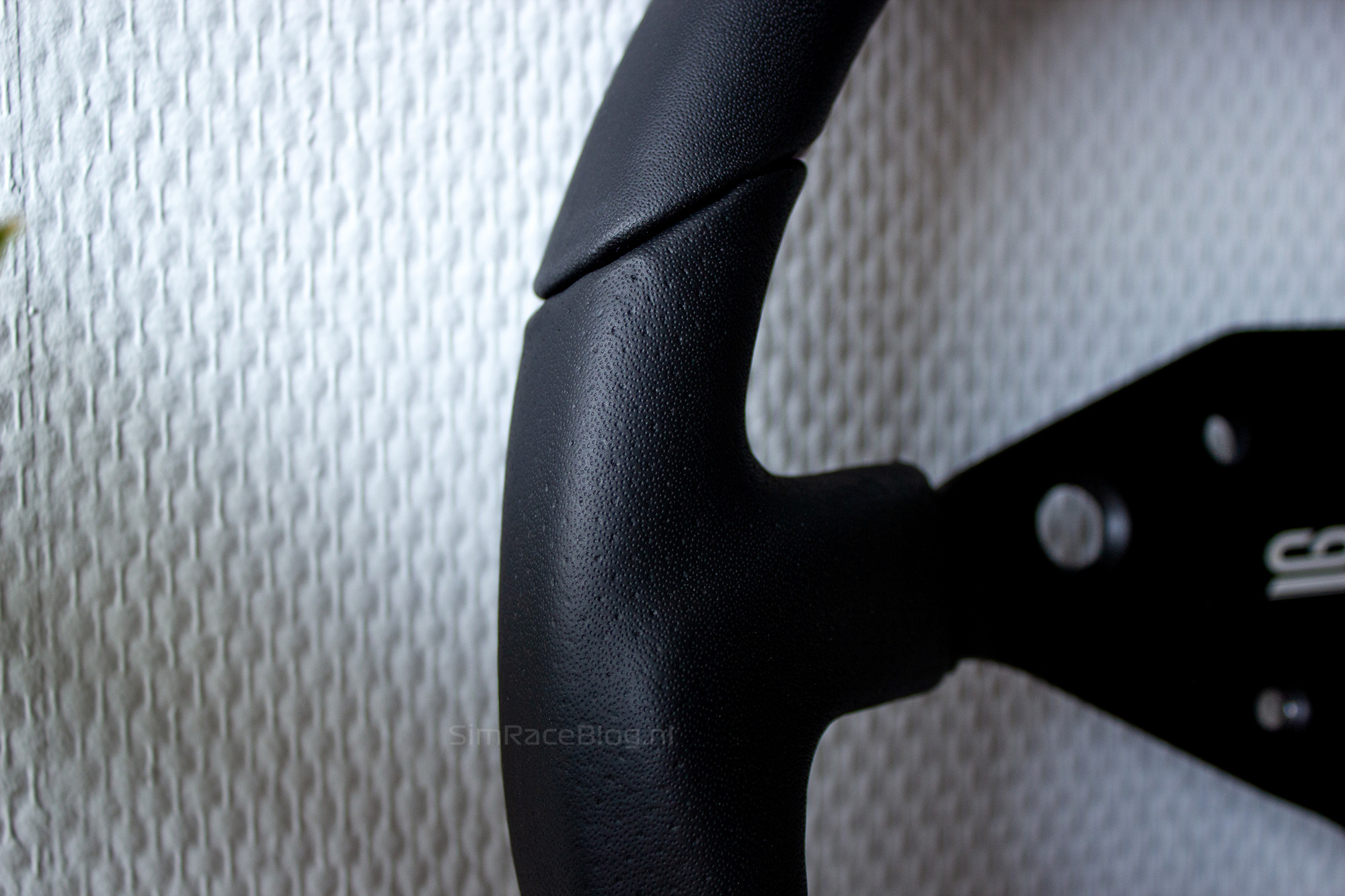
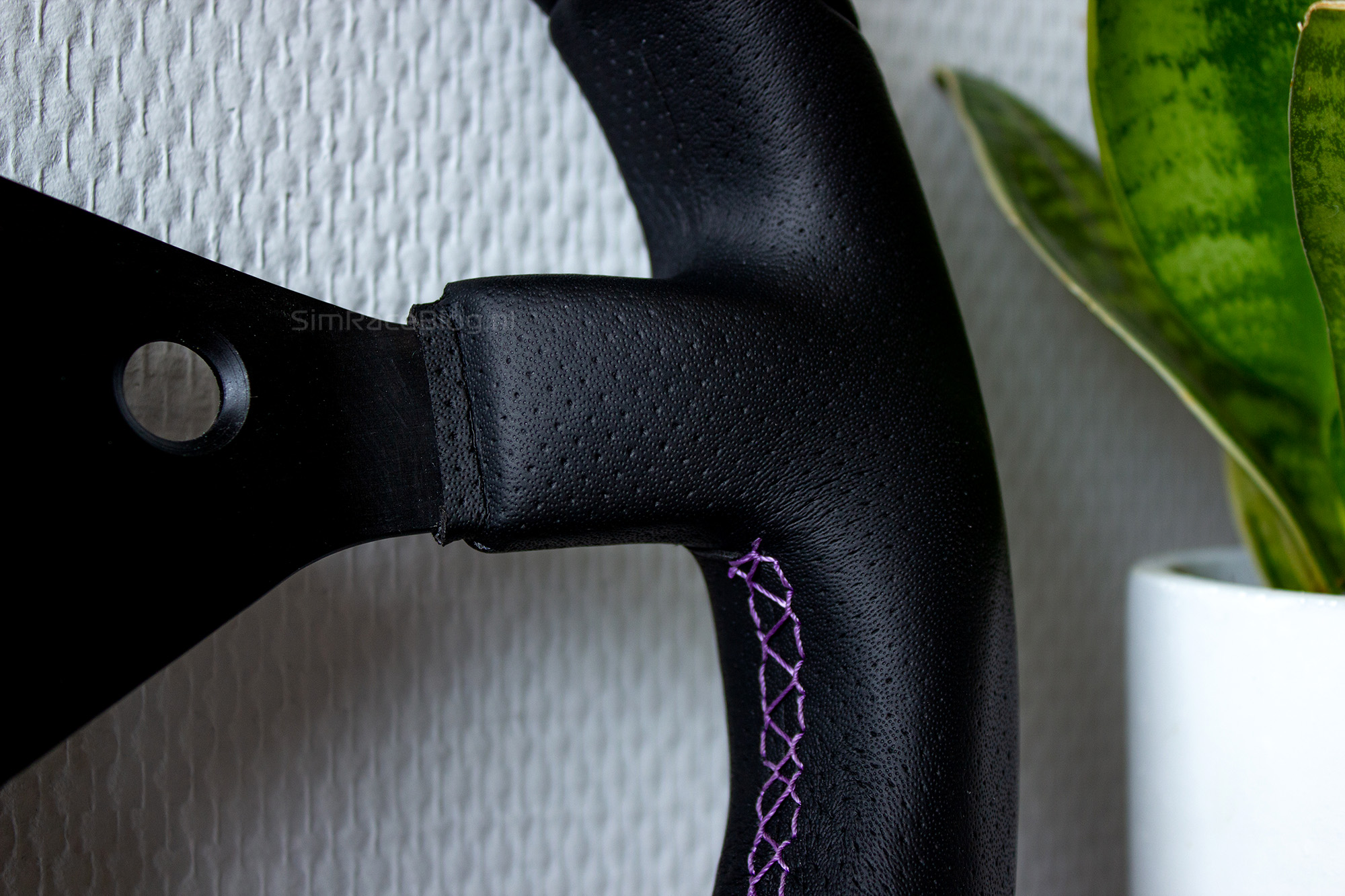
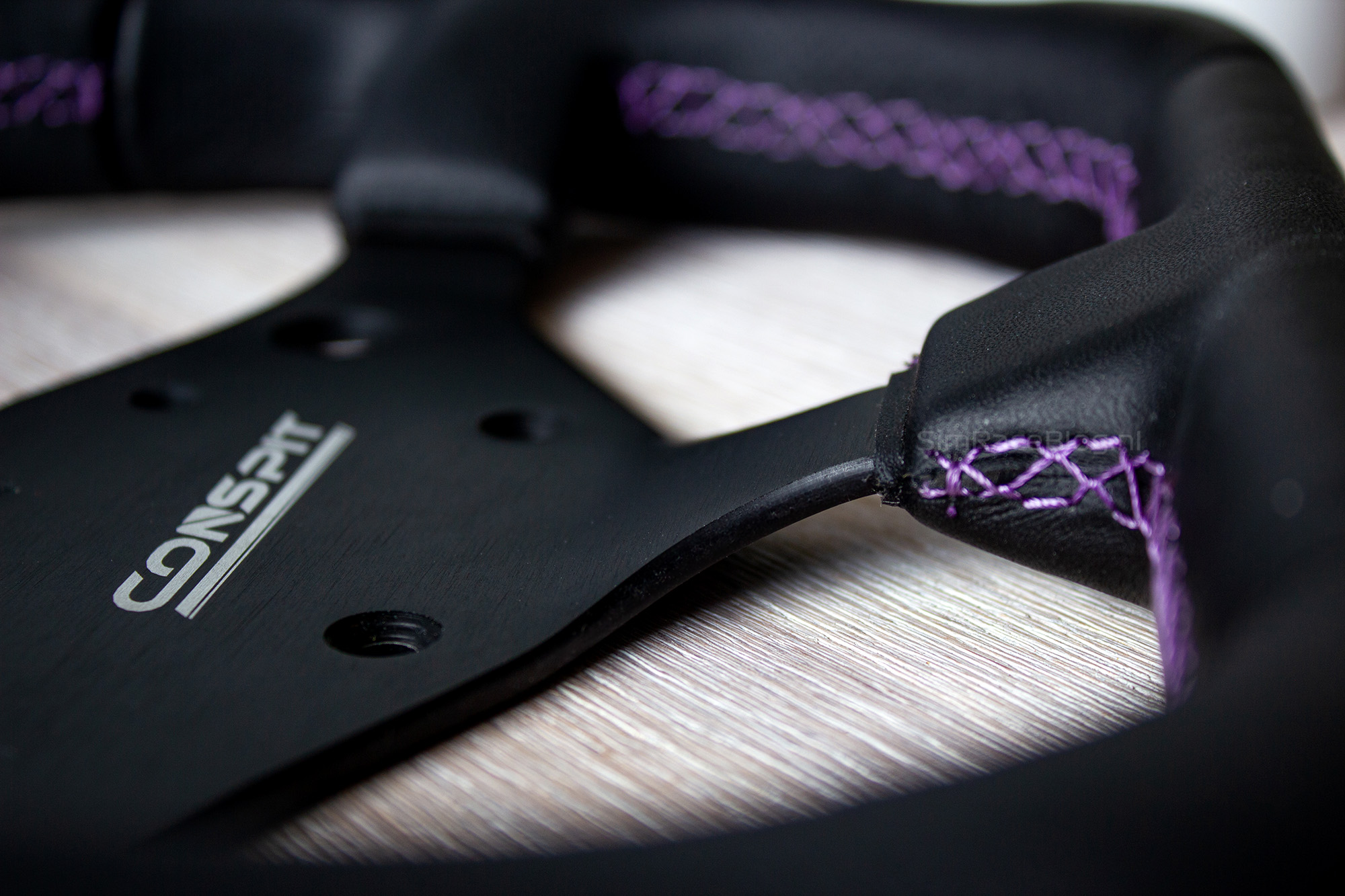
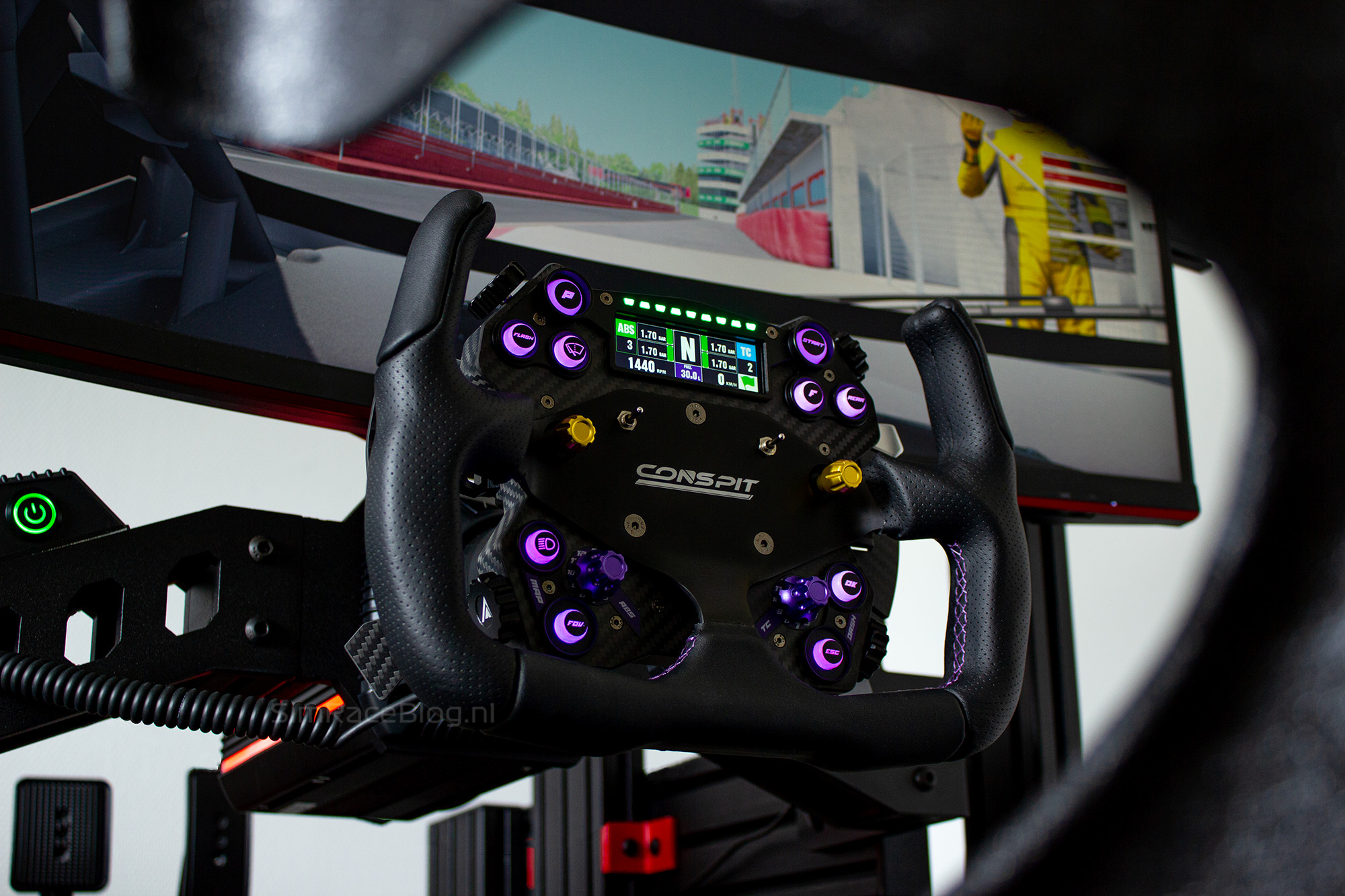
The last wheel rim we received is the CX295 rim. This is a wheel with an open top, giving it a shape resembling the letter “C”. Unlike the other steering wheels with a diameter of 320mm, this open wheel is slightly smaller at “just” 295mm. Despite its flat bottom giving it a resemblance to the DX320 at first glance, there are certainly some differences between the steering wheels. The CX295 steering wheel has a more eccentric shape due to some subtle notches at the bottom and at the grips. In terms of covering, the CX295 is similar to its counterparts, featuring synthetic leather upholstery with perforated leather grips. While purple stitching is used here as well, there’s no purple top marker since this steering wheel lacks a top-side.



Assembly
Before we can put the Conspit H.AO HUB to the test, we need to assemble it. The included quick guide provides simple and clear instructions on the steps to follow and the materials needed. The first step is to attach all four of the included paddles for the shifters and the clutch. Attaching these is relatively effortless. It’s a bit fiddly with the small screws, but it’s very straightforward, making it a task of just a few minutes.
The next step is to mount a quick-release system. Before we can do this, we first plug the included data cable into the back of the wheel. Since the H.AO only has three mounting holes on the back, we need to first attach the included adapter. This adapter is hollow and has a small passage on the mounting surface for the quick-release, allowing the data cable we just plugged in to pass through easily, ensuring it won’t be in the way during use. On the back of the adapter, there’s a 70mm hole pattern compatible with most common quick releases. Since we want to test the Conspit H.AO on our Asetek Invicta wheelbase, we attach the Asetek Invicta Quick Release Adapter. This also went smoothly for us, with the quick release being installed in no time.


Now that the foundation is set, we can choose the first wheel rim to mount on the button box. The first rim we’ll attach is the DX320. The quick guide provides a concise description of how to mount the included steering wheels. When mounting Conspit’s own wheel rims, it’s important to remove the caps of the Funky-Switches before placing the wheel. Once removed, the holes of the button box and the wheel can be aligned and secured with three countersunk screws. After tightening these, the caps of the Funky-Switches can be reattached, and a thin nut included in the package can be placed to complete the installation of the Two-Way-Switches.


On the Conspit H.AO HUB, not only Conspit’s own wheel rims can be mounted, but any other rim with a similar hole pattern can also be installed. However, a potential issue arises when we realize that wheel rims from other manufacturers won’t have pass-through holes for Conspit’s Funky-Switches and Two-Way-Switches. Fortunately, Conspit has thought of this. As we briefly mentioned earlier in the review, the aforementioned switches are placed on magnetic modules. This allows them to be easily removed from the button box, ensuring they won’t obstruct the placement of another wheel. The trade-off that needs to be made, however, is that some input options will no longer be available on the H.AO.

The final touch we’re going to apply to complete the overall look is to sticker the buttons. Conspit has provided a generous selection of stickers for the H.AO, and they’ve even doubled up on them. Each sticker comes in both black and Conspit purple. This means we have a total of four sticker sheets, one in each color for the buttons and one in each color for labeling the encoders. Despite the abundance and variety of stickers provided, there’s a small omission. While some manufacturers include a simple plastic tweezer, Conspit’s packaging lacks this. Luckily, we have a few lying around that we can use because to ensure the stickers stay neat and durable, it’s best to minimize contact with fingers as much as possible.


Software
With the Conspit H.AO HUB fully assembled, we can connect it to our PC. The first step is always to download the appropriate software. The software, called Conspit Link, can easily be obtained and installed on our computer via the Conspit website. After completing the installation, we initially connect the H.AO via the USB input on our Quick Release. Although this provided power to our wheel, it wasn’t recognized by the software. During our review period, we contacted both Conspit and Asetek, but we haven’t yet discovered the cause. Fortunately, there’s nothing wrong with the Conspit H.AO HUB itself, and it works perfectly when plugged directly into our USB hub.
Regarding the software itself, we can’t provide much detailed information. This is because the H.AO hasn’t officially launched yet, and the software is still in an earlier stage when it comes to the steering wheel. Therefore, not all functions work as they should in the final stage, and not all options are available to us yet. It wouldn’t be fair to form an opinion about the current software. However, we’ll briefly go through the menus to indicate what should be possible at release.
In the main menu of the software, the My Devices section immediately recognizes that the H.AO hub is connected. Clicking on the H.AO HUB leads us directly to the setup page of the button box, which contains three different tabs. These are RGB Settings, Paddles Settings, and Firmware Update. In the first tab, RGB Settings, we see a menu where, as the name suggests, we can manage the LEDs on the button box. Here, we can adjust the backlight of each button and set what each LED should do in different situations. For each LED in the RPM LEDs, we can specify at which RPM it should activate. In the Paddles Settings section, we can currently only calibrate both the shifters and the clutch. There’s already a bar indicating how far the clutch is pressed, but setting a bite point for the dual-clutch is missing in the current version. This should be possible in the future. The last tab, Firmware Update, will allow us to display the current firmware version and install any available new versions.


To configure the steering wheel at the moment, we use the setup mode. When we pull both Swift-Triggers™ towards us, we see our RPM LEDs light up one by one. Releasing them when the entire RPM gauge is lit up puts us in a setup mode. From this mode, we can use the various thumb encoders to adjust the brightness of the LEDs and the display. We can also choose from a selection of dashboard presets to be displayed on the screen. Additionally, in this mode, we can determine the backlight color for each button individually, allowing us to fully customize the steering wheel to our liking. To exit this setup mode, we simply push the Swift-Triggers™ away from us until all RPM lights are off again.
Using the Conspit H.AO HUB
With all the preparatory tasks completed, it’s time to put the Conspit H.AO HUB to the test. We’ll do this by using the variety of wheel rims in multiple sims, with Assetto Corsa, Assetto Corsa Competizione, and DiRT Rally 2.0 taking the lead. This way, we can expose the H.AO to different disciplines to get a comprehensive picture of its performance.
The Conspit H.AO HUB
The Conspit H.AO HUB leaves a good first impression on us. All the push buttons provide pleasant feedback and are easy to press. However, this doesn’t mean that the buttons are insensitive; they do require some convincing force to operate. The audible click when pressing the buttons is, in our opinion, a bit on the loud side, but with headphones on, it’s more bothersome for those around us than for ourselves.
We find the thumb encoders on the H.AO very comfortable. Although they are easy to turn, there are clear steps felt in the operation. To move to the next step of the encoder, we need to turn the wheel on the encoder relatively far, but not annoyingly so. This makes these encoders easy to operate while also being well-protected against accidental operation. One drawback we encountered with the thumb encoders at the bottom is that sometimes, while we are not in setup mode, they still retain the setup functions. That is to say, if, for example, we operate the thumb encoder at the bottom right, the dashboard changes. However, we expect this to be addressed in the official launch of the H.AO.
Furthermore, we also have the purple rotary knobs on the front of the steering wheel. In our opinion, these are among the finest rotary encoders we have felt so far. They feel sturdy, sit comfortably in place, and, in combination with the stickers, clearly indicate their position. This is important because, at the moment, these dual-mode encoders only provide a fixed value. In the future, they should also function in the mode where they provide a repeated + or – pulse, but we cannot adjust this in the current beta software.
Regarding the two Funky-Switches, we can be brief; they work exactly as expected. The rotating function and the directional functions are easy to operate. One small downside, in our opinion, is that these Funky-Switches feel relatively loose, with quite a bit of play on the stick itself. As a result, we found the button function of these switches less pleasant, so we hardly used them. That being said, we believe these two switches definitely add value to the button box itself.
Finally, there are also two Two-Way-Switches on the front of the H.AO. These feel rather simple but are perfectly usable. Because the operating direction is somewhat angled, with the operating direction not perfectly vertical but operated at an angle of about 45 degrees, these switches are easy to operate with the thumb.
At the back of the Conspit H.AO HUB, we find components that give us a good feeling. To begin with, the clutch levers at the bottom are well-placed and provide a pleasant resistance when we engage them. This resistance is not too heavy and can be dosed smoothly with the pinky and ring finger for a smooth start.
The second set of paddles at the back are those of the shifter modules. Straight out of the box, the shifters of the H.AO feel comfortable and familiar. Thanks to the magnets embedded in the module, we feel comfortable feedback when shifting gears, requiring a comfortable amount of force to change gears. Although the shifter modules feel great right out of the box, we still want to explore the adjustment options to see if they can be adjusted completely to our liking. The possibilities of the shifter modules are quite comprehensive; we can adjust the distance to the steering wheel both in depth and in width, and adjusting the travel is also possible. Thus, in no time, we adjust the paddles closer to the steering wheel and halve the travel to maximize our driving experience.
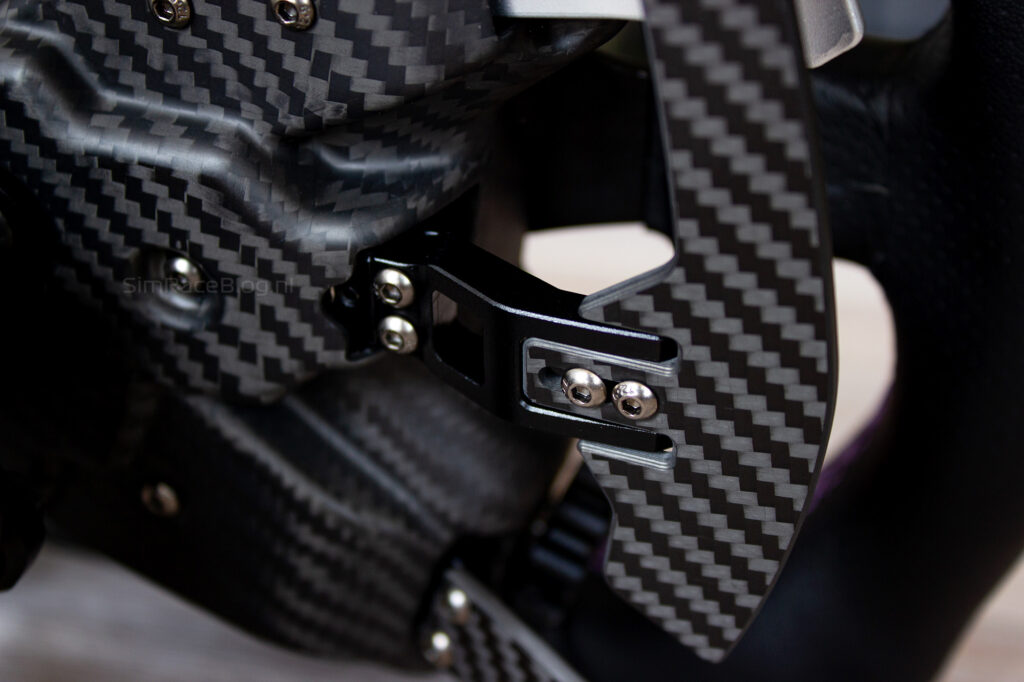

The Swift-Triggers™ at the back of the steering wheel left the strongest impression on us. These push-and-pull paddles are always within reach of our index finger while driving, making them quick and easy to operate even without looking. With the ability to both pull and push, they offer four input options that are incredibly convenient to use. We find them perfect for tasks such as activating the DRS and flashing the headlights.
In addition to all the buttons, the Conspit H.AO HUB also features nine RPM LEDs and a small digital display. Both the LEDs and the display itself have a decent brightness level, which can be adjusted. Personally, we prefer to set them at about halfway to their maximum, ensuring good visibility without being blinding, especially in low-light conditions. The hub’s screen currently isn’t compatible with SimHub yet, but it does come with three simple dashboards by default. These dashboards display basic information such as RPM, current gear, and speed, among others.


The DX320 Wheel Rim
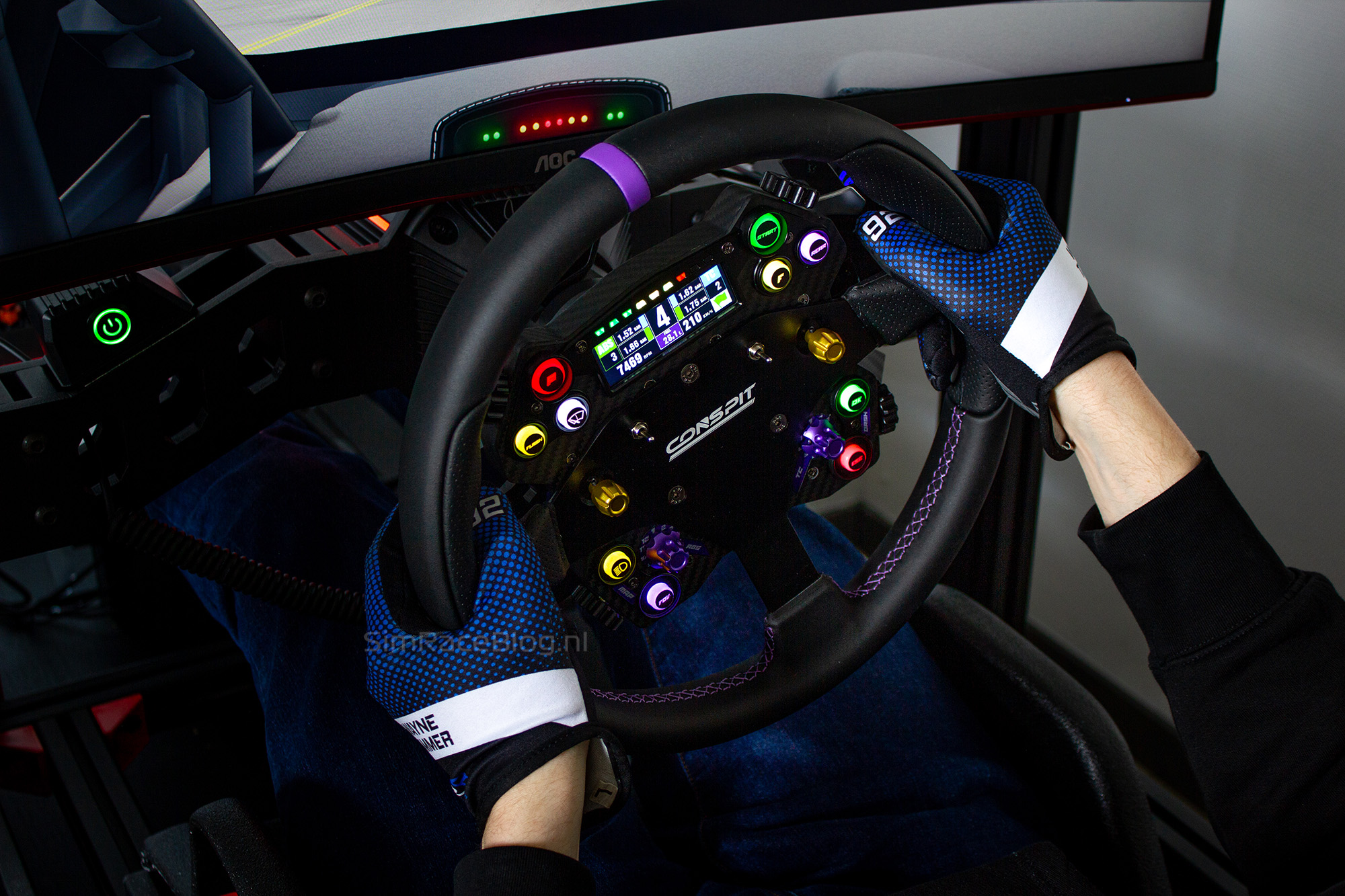
The Conspit H.AO HUB can only be used in combination with a separate wheel rim. As hinted in the assembly section, we started by attaching the DX320 wheel. When we first grip the wheel, it feels comfortable. The synthetic leather has a soft touch, and the thickness of the steering rim adds to the overall comfort. However, the wheel does feel a bit slippery, although its design provides enough grip to prevent it from slipping out of our hands.
Unfortunately, the steering wheel is not without its drawbacks. During our initial laps on the virtual track, we encounter a minor issue. Due to the design of the hub’s center, which protrudes slightly forward at the connections with the outer rim, we can barely reach two buttons on the button box. The rim of the steering wheel protrudes too far forward to comfortably operate the H.AO HUB, requiring us to partially or even completely remove our hand from the grip to access the buttons. This is something we prefer not to do while racing.
Fortunately, the design of the DX320 rim also has its advantages. We tested the Conspit H.AO HUB on our Formula Sim Rigs Avanzata, where we sit in a formula-style position. This means we look directly over the steering wheel at the screen. While traditional round wheels and D-shaped wheels, such as those found on the Asetek Forte Button box, can sometimes obstruct our view of the screen, this is not the case with the DX320 wheel. Thanks to Conspit’s decision to flatten the top of the steering wheel, we have a much clearer view of our screen.


Exhanging Rims
After having covered some ground with the DX320 wheel, we are going to replace it with the round wheel rim we received, the RX320. We can describe the process of switching these rims as quite fast and simple. First, we remove the gold caps from the Funky-Switches, each secured with one set screw. Next, we unscrew the locking nuts of the Two-Way-Switches and remove the three Allen screws that secure the steering wheel. We swap out the DX320 wheel for the RX320 and then reattach everything in reverse order. The entire process took us just a few seconds over 2 minutes, and not a drop of sweat was shed. This makes the swapping process considerably faster than the swapping process with the Asetek Forte Button Box, which took us 5 minutes.
The RX320 Wheel Rim
With the round RX320 wheel rim in place, we can also test this ons properly. Like the DX320, this wheel rim has a diameter of 320mm, which makes it a pleasant size. The artificial leather upholstery also feels soft but also somewhat slippery on this steering wheel. In contrast to the other steering wheels, the handles of the RX320 steering wheel are less contoured to keep the outside of the steering wheel completely round. This makes it less comfortable holding the steering wheel for us, but makes the wheel is very suitable for drifting, where we can easily let the steering wheel slide through our hands. In our opinion, the RX320 rim seems to be a little less far forward than the DX320, although we cannot press the buttons on this steering wheel without releasing our hands (slightly). This is not a problem for the round steering wheel, as we hardly use the buttons on the steering wheel during drifting and rally racing.

The CX295 Wheel Rim
Although the CX295 wheel rim has a smaller diameter than the other two rims (295mm compared to 320mm), it does not feel smaller. Due to its somewhat unique shape, the CX295 wheel is the wheel that is most comfortable to hold. Where the artificial leather covering of the handles feels relatively smooth, the pre-formed handles also offer a good degree of grip while driving. But unfortunately, just like with the other wheel rims, the handles of the rim are also so far forward, making it very difficult for us to easily operate the buttons. However, with the open top of the steering wheel, it does offer us the best view of our screen.


Conclusion
After testing the Conspit H.AO HUB for a few weeks, we have to say that we can end this review with a positive feeling. As Conspit has done in the past with their other products, they once again manage to leave a good impression on us with a beautiful product.
The experience starts when you unpack the H.AO, which is packaged in a very neat box. The additional wheel rims are unfortunately packaged in somewhat simpler boxes, but this certainly does not detract from the product itself.
The Conspit H.AO HUB itself is absolutely nothing short of an amazing looking button box. With its housing made entirely of carbon, it is one of the most beautiful button boxes we have had in our hands. On top of that, it is also packed with input options, including the unique and very pleasant Swift-Triggers™. Every form of input feels solid and is pleasant to operate, although we must say that the push buttons are a bit on the loud side and we feel that the Funky Switches have a little too much play. However, this does not detract from the positive impression that the rest of the H.AO HUB conveys. In addition to the inputs, the Conspit H.AO HUB is also equipped with nine speed LEDs and a digital display, both of which have good (adjustable) brightness and are easy to read both during the day and at night.
We can do very little with just the button box itself, which is why Conspit also sent three separate wheel rims to attach to the H.AO HUB itself. A job that we can easily get done in just a few minutes. We can say that the D-rim (DX320), the round rim (RX320) and the open rim (CX295) are beautiful wheel rims to look at. Due to their artificial leather upholstery, unique shapes and purple details, they each have a unique appearance. Even though the artificial leather is relatively smooth, the shape of each rim ensures that we maintain sufficient grip on the handles, both with and without gloves. Unfortunately, a small disadvantage that we experience with every wheel rim is that in our opinion the handles are a bit too far forward, making it difficult to operate the buttons while holding the steering wheel. To operate the buttons we have to partially or even completely take our hands off the grips, something we prefer not to have while racing. Nevertheless, it remains easy to use and does not detract too much from the overall experience.
Bottom line, we think that Conspit has created a very complete and strong product with the H.AO HUB. The H.AO will reportedly have a price tag of approximately €580 and a price of €650 including one wheel rim. Although it will not be the cheapest hub-wheel combination, we think it is a very reasonable price for what you get in return. This should make the H.AO a serious consideration for any sim racer when looking for a central hub with separate wheel rims.
Do you want to stay informed about SimRaceBlog content, news, announcements and (future) give-aways? Follow us on Instagram @simraceblognl and/or our Discord channel.